


What Is SCU Urea? Benefits, Nitrogen Release, and Agricultural Applications

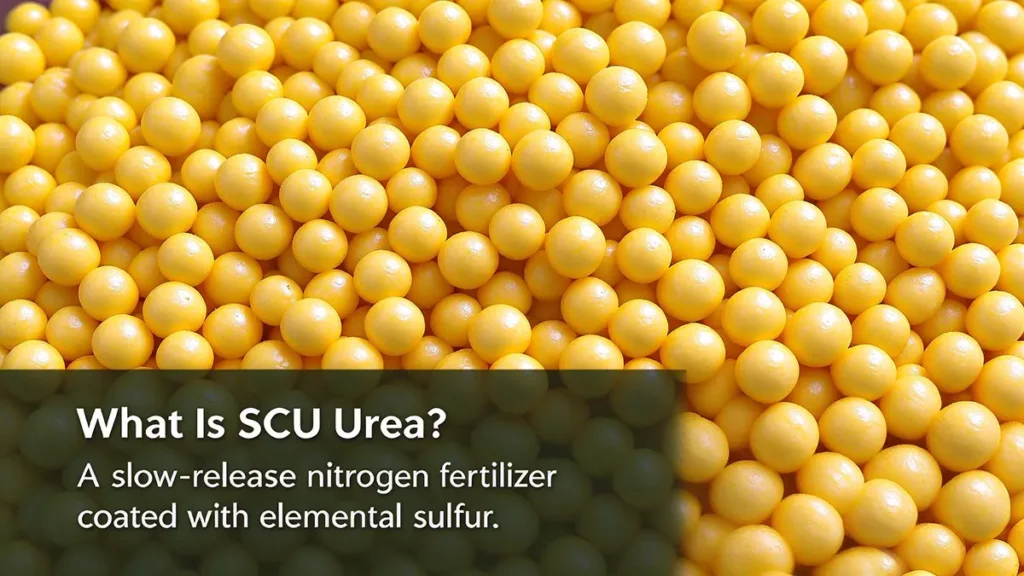
Sulfur-coated urea (SCU) is a slow-release nitrogen fertilizer made by coating urea granules with elemental sulfur. The coating acts as a physical barrier that regulates water penetration and nitrogen release, helping extend nitrogen availability compared with conventional, uncoated urea.
SCU is used in agricultural and horticultural systems where a longer nitrogen supply may be beneficial, including turfgrass management, selected field crops, sugarcane, fruit production, and forage systems. Its performance depends on coating quality, soil temperature, moisture conditions, and the timing of fertilizer application relative to crop demand.
For agricultural buyers evaluating sulfur-coated urea, Terafon Fertilizer’s SCU product information provides a starting point for understanding this fertilizer category. As with any fertilizer, product selection should ultimately be based on verified nutrient specifications, nitrogen-release characteristics, and the intended agricultural application.
Table of Contents
- 1. What Is SCU Urea?
- 2. How Does Sulfur-Coated Urea Work?
- 3. SCU Urea Composition and Technical Specifications
- 4. Key Benefits of SCU Urea
- 5. SCU Urea vs. Conventional Urea vs. Polymer-Coated Urea
- 6. Agricultural Applications of SCU Urea
- 7. How to Apply SCU Urea Effectively
- 8. Factors Affecting Nitrogen Release
- 9. Limitations and Considerations
- 10. How to Evaluate SCU Urea Quality
- Conclusion: Choosing the Right Seaweed Fertilizer Partner
1. What Is SCU Urea?
SCU stands for sulfur-coated urea, a nitrogen fertilizer manufactured by covering urea granules or prills with a layer of molten elemental sulfur. Many conventional formulations also use a sealant, such as wax or an oil-based material, to close pores and imperfections in the sulfur coating.
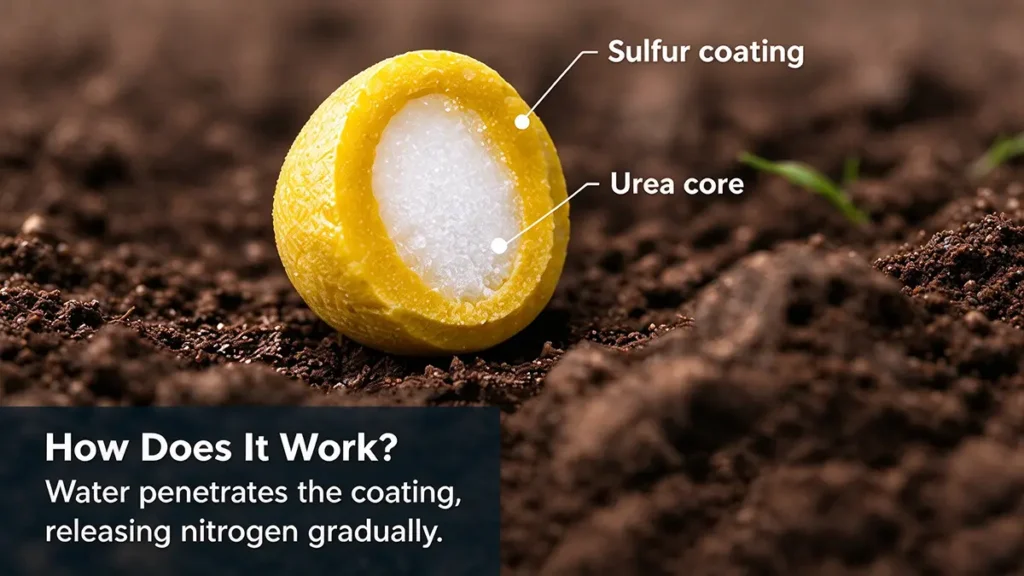
The urea core provides nitrogen, while the sulfur coating regulates how quickly water enters the granule and how dissolved nitrogen is released into the surrounding soil.
Unlike conventional urea, which can dissolve rapidly when sufficient moisture is available, SCU is designed to extend nitrogen release. However, the sulfur coating does not form a perfectly uniform or permanently impermeable barrier. Its thickness, integrity, and susceptibility to physical damage all influence the release pattern.
According to Penn State Extension’s turfgrass fertilization guide, SCU nitrogen concentrations commonly range from approximately 32% to 43%, depending on coating thickness and formulation.
This lower nitrogen concentration compared with conventional urea is an important consideration when calculating application rates, transport costs, and the cost per kilogram of nitrogen supplied.
What makes SCU different from ordinary urea?
The primary difference is the coating rather than the underlying nitrogen source.
SCU is often marketed as a slow-release fertilizer. Although the terms slow-release and controlled-release are sometimes used interchangeably in commercial descriptions, conventional sulfur coatings generally provide less predictable release than well-engineered polymer coatings.Understanding this distinction helps growers and fertilizer distributors compare products on technical performance rather than terminology alone.
| Characteristic | Conventional urea | Sulfur-coated urea |
|---|---|---|
| Main nitrogen source | Urea | Urea |
| Typical nitrogen content | Approximately 46% | Approximately 32–43%, depending on formulation |
| Sulfur coating | No | Yes |
| Nitrogen release | Relatively rapid after dissolution | Delayed by the coating, with release affected by pores and cracks |
| Additional sulfur contribution | Not inherent to the product | Usually present as elemental sulfur in traditional formulations |
| Release consistency | Not designed for extended release | Can vary with coating quality and granule integrity |
| Typical role | Rapid nitrogen supply within a fertilizer program | Extended nitrogen supply where appropriate |
2. How Does Sulfur-Coated Urea Work?
SCU releases nitrogen through a combination of moisture penetration, dissolution of the urea core, movement through coating defects, and physical or biological deterioration of the coating system.
Stage 1: Water penetrates the sulfur coating
After application, water from soil moisture, rainfall, or irrigation can gradually enter the granule through pores, cracks, or other imperfections in the sulfur layer.
The coating delays direct water contact with the urea core, but the extent of this delay varies from granule to granule.
Stage 2: The urea core dissolves
Once water enters the granule, the urea dissolves and forms a concentrated solution inside the coating.
As more water penetrates, dissolved urea can move outward through available openings. Differences in coating integrity can cause individual granules to release nitrogen at different rates.
Stage 3: Nitrogen release continues or accelerates
SCU release may increase when the sealant deteriorates, coating imperfections become more pronounced, or the sulfur layer fractures.
If a coating breaks, the urea core may be exposed and dissolve much more rapidly than expected. This phenomenon is one reason sulfur-coated urea can exhibit greater variability than some polymer-coated fertilizers.
A peer-reviewed study published in PLOS ONE, Nitrogen release rates from slow- and controlled-release fertilizers influenced by placement and temperature, discusses the different release behavior of sulfur-coated and polymer-coated fertilizers.
Stage 4: Soil processes make nitrogen available to crops
After urea is released into the soil, it undergoes hydrolysis to form ammonium-containing compounds. Depending on soil conditions, microorganisms can subsequently convert ammonium into nitrate through nitrification.
Plants can absorb nitrogen mainly as ammonium and nitrate. How effectively they use it depends on root activity, crop growth stage, soil conditions, and the timing of nutrient availability.
An important distinction: SCU delays the release of the nitrogen source; it does not prevent nitrogen from undergoing the normal chemical and biological transformations that occur in soil.
How long does SCU urea last?
There is no single release duration that applies to all SCU products.
The effective release period depends on coating thickness, sealant quality, soil temperature, moisture, microbial activity, and granule damage. A product’s stated release period should therefore be supported by technical data and evaluated under conditions relevant to its intended use.
For agricultural buyers, a measured release curve is generally more informative than a supplier’s unqualified claim that a fertilizer lasts for a particular number of days.
3. SCU Urea Composition and Technical Specifications
The nutrient analysis of SCU depends on the proportion of the urea core retained in the finished granule and the quantity of sulfur and other coating materials used.
A thicker or heavier coating generally reduces the percentage of nitrogen in the finished product. Conversely, a product containing a higher proportion of urea may have a higher nitrogen concentration but may require a different coating design to achieve the desired release behavior.
The following characteristics are useful when evaluating commercial SCU products.
| Parameter | Technical significance |
|---|---|
| Total nitrogen (N) | Determines the quantity of nitrogen supplied per unit of fertilizer |
| Total sulfur (S) | Indicates the amount of sulfur contributed by the product |
| Coating composition | Helps identify the coating system and any sealant materials |
| Coating integrity | Influences the likelihood of premature nitrogen release |
| Particle size | Affects spreading performance, blending, and physical handling |
| Moisture content | Supports quality assessment and storage management |
| Biuret content | Helps assess the chemical quality of the urea-based fertilizer |
| Dissolution rate | Indicates how much material dissolves within a specified test period |
For SCU, the internationally published standard ISO 17322:2015, Fertilizers and soil conditioners — Analytical methods for Sulfur Coated Urea (SCU), specifies analytical methods for total nitrogen, one-day dissolution rate (1DDR), seven-day dissolution rate (7DDR), sulfur, biuret, moisture, and particle size. The standard was reviewed and confirmed current in 2025, according to the International Organization for Standardization (ISO).
These test parameters make it easier for buyers to compare products using documented measurements.
However, an analytical method is not the same as a product acceptance specification. Buyers should establish the required values and tolerances in their purchase specifications rather than assuming that compliance with a test method guarantees a particular field-release period.
Stage 4: Soil processes make nitrogen available to crops
Consider a fertilizer program requiring 100 kg of total nitrogen per hectare.
For conventional urea containing 46% N:
100
0.46
=
217.4
kg/ha
For SCU containing 36% N:
100
0.36
=
277.8
kg/ha
The calculated product quantities are therefore approximately 217.4 kg/ha and 277.8 kg/ha, respectively.
This calculation compares total nitrogen content only. It does not imply that all nitrogen becomes available at the same time or that the two products will produce identical crop responses. Actual fertilizer programs must account for soil conditions, crop nutrient requirements, and product-release characteristics.
4. Key Benefits of SCU Urea
The value of sulfur-coated urea comes primarily from its potential to extend nitrogen availability and reduce the need for frequent applications in suitable production systems.
These benefits depend on whether the release pattern matches crop demand.
4.1 Extended nitrogen availability
Conventional urea can supply nitrogen quickly when adequate moisture is present. In longer growing cycles, however, the initial nitrogen supply may not cover the entire period of crop demand.
SCU can extend nitrogen delivery by delaying water penetration and limiting how rapidly the urea core dissolves and escapes from the granule.
This characteristic can be useful in crops or managed landscapes where nitrogen is needed over an extended period rather than in a single short growth phase.
4.2 Potential to reduce application frequency
A fertilizer that releases nitrogen over a longer period may reduce the number of fertilizer applications required during a growing season.
This can lower labor and machinery requirements, particularly in turf management, forage production, and fields where repeated access is inconvenient.
Nevertheless, SCU does not automatically replace a complete split-application program. The appropriate application schedule depends on the crop’s growth cycle and the release behavior of the selected product.
4.3 Potential to improve nitrogen-use efficiency
Nitrogen-use efficiency describes how effectively applied nitrogen contributes to crop growth and harvested output, depending on the definition used in a particular study.
SCU can help improve the timing of nitrogen availability relative to plant uptake. By delaying release, it may reduce the amount of nitrogen exposed to loss processes before the crop can use it.
However, SCU does not guarantee higher nitrogen-use efficiency in every field. If its coating releases nitrogen too early, or if nitrogen remains unavailable during a critical growth stage, the expected advantage may be reduced.
The relationship between placement, temperature, coating behavior, and nitrogen release is discussed in the previously cited PLOS ONE study.
4.4 Additional sulfur supply
Traditional SCU contributes elemental sulfur through its coating.
Sulfur is essential for plant protein formation and other physiological processes. However, elemental sulfur must be oxidized by soil microorganisms into sulfate before plants can absorb it efficiently.
The rate of this conversion varies with temperature, moisture, particle characteristics, and soil biological activity.
Therefore, although SCU can contribute sulfur to a nutrient management program, its sulfur content should not automatically be considered equivalent to an immediately available sulfate source.
4.5 Greater flexibility in fertilizer management
Where longer nitrogen availability is agronomically useful, SCU can provide additional flexibility in planning fertilizer applications.
The strongest case for using SCU is one in which the value of extended nutrient supply or reduced application frequency outweighs the additional product cost and the uncertainty associated with coating performance.
The objective should be to match nutrient release to crop demand, not simply to maximize the number of days stated on a fertilizer label.
5. SCU Urea vs. Conventional Urea vs. Polymer-Coated Urea
SCU, conventional urea, and polymer-coated urea (PCU) all provide nitrogen, but their release mechanisms and management characteristics differ.
| Feature | Conventional urea | Sulfur-coated urea (SCU) | Polymer-coated urea (PCU) |
|---|---|---|---|
| Coating material | None | Elemental sulfur, sometimes with a sealant | Polymer membrane |
| Nitrogen content | Approximately 46% | Commonly 32–43%, formulation-dependent | Depends on the product formulation |
| Main release mechanism | Dissolution after contact with sufficient moisture | Water entry and nitrogen escape through pores, cracks, or damaged coating | Water penetrates the polymer membrane and dissolved nutrients diffuse outward |
| Release consistency | Rapid nutrient supply rather than extended release | May vary considerably among granules | Can be engineered for a more consistent release profile |
| Sulfur contribution | None inherent to uncoated urea | Elemental sulfur is usually present | Not necessarily present |
| Product cost | Often lower per unit of nitrogen | Depends on coating and formulation | Often higher than conventional urea, depending on the product |
| Main consideration | Timing and split applications | Coating quality and release variability | Release characteristics and compatibility with crop demand |
The comparison reflects general product-category differences, not universal specifications. Actual nitrogen concentration, release performance, and price should be verified from supplier documentation.
Which fertilizer is the better choice?
Conventional urea is often appropriate when a relatively concentrated nitrogen source is required and the grower can manage application timing effectively.SCU may be more suitable when a longer nutrient supply offers practical benefits and its release profile is appropriate for the crop and local environment.Polymer-coated urea may be preferred when a more precisely engineered release profile is important, provided the product’s technical data justify the additional cost.A proper comparison should evaluate:
- Cost per kilogram of nitrogen.
- Expected nitrogen release under local soil and climate conditions.
- Application frequency and labor costs.
- Crop duration and nutrient demand.
- Sulfur requirements and other fertilizer inputs.
- Evidence supporting the claimed release period.

6. Agricultural Applications of SCU Urea
SCU is most relevant to agricultural systems where an extended nitrogen supply can support crop management or reduce the inconvenience of frequent fertilization.
Its suitability must be assessed for each crop and production environment.
6.1 Turfgrass and landscape management
Turfgrass is an established application area for sulfur-coated urea.
Golf courses, sports fields, parks, and managed lawns often require consistent growth and color over extended periods. Frequent fertilizer applications can increase maintenance costs and disrupt site operations.
SCU may help extend nitrogen delivery between applications. The selected formulation should reflect turf species, growth conditions, expected maintenance frequency, and the required appearance.
Application rates should be based on local turf-management recommendations, soil testing where appropriate, and the manufacturer’s product instructions.
6.2 Sugarcane and other long-duration crops
Sugarcane has a relatively long growing cycle, with nitrogen demand influenced by growth stage, soil fertility, irrigation, and regional production practices.
SCU may be considered where an extended nitrogen supply is desirable or where repeated fertilizer applications are difficult to schedule.
Other long-duration crops and forage systems may also benefit from an appropriately timed nitrogen supply. However, the release period must match the crop’s actual uptake pattern, and the economics should be compared with conventional split applications.
6.3 Fruit production
Some fruit-growing systems, including strawberries and cranberries, can require sustained nutrient management throughout portions of the growing season.
SCU may be appropriate where its release characteristics fit the crop’s nitrogen demand and root-zone environment.
Nevertheless, fruit crops differ considerably in rooting depth, production cycle, soil preference, and fertilizer sensitivity. A product suitable for one crop or region should not automatically be recommended for another.
6.4 Rice production
Rice presents particular challenges because water management strongly influences nitrogen transformations and potential nutrient losses.
SCU has been investigated for rice production, but results depend on the product, placement, soil conditions, and irrigation regime.
Continuous flooding, intermittent irrigation, and alternate wetting and drying can create different nitrogen dynamics. Local trials and agronomic recommendations should guide the selection of SCU and the timing of application.
6.5 Sandy soils and high-rainfall environments
Sandy soils generally have lower water-holding capacity than finer-textured soils. When substantial rainfall or irrigation occurs, nitrate released into the root zone can move downward with drainage water.
In such environments, SCU may help by delaying nitrogen release and reducing the amount of nitrogen available before crop uptake.
However, the benefit is conditional. SCU does not eliminate nitrogen leaching, and a damaged or inconsistent coating may release nitrogen earlier than expected.
Management of irrigation, fertilizer timing, soil properties, and crop uptake remains essential.
7. How to Apply SCU Urea Effectively
Effective use of SCU begins with the crop’s nutrient requirement and the actual release characteristics of the selected product.
A product should not be applied at a generic rate solely because it is described as slow-release.
Broadcast application
Broadcasting is used in turfgrass, forage, and selected field-crop systems.
Uniform distribution is important because uneven application can create localized areas of excessive or insufficient nitrogen supply. Spreader calibration is particularly important when SCU is blended with other granular fertilizers.
Soil incorporation and placement
Depending on the crop and production system, SCU may be broadcast onto the soil surface, incorporated, or placed using an appropriate fertilizer-placement method.
The manufacturer’s instructions should be followed because excessive mechanical damage can fracture sulfur coatings and accelerate nitrogen release.
Placement should also account for crop rooting patterns, soil moisture, and the risk of nutrients becoming available outside the main period of crop demand.
Application timing
SCU should be applied early enough for nitrogen to become available during the intended growth period, but not so early that substantial nutrient release occurs before crop uptake can begin.
Timing should reflect:
- Crop species and growth stage.
- Expected soil temperature and moisture.
- Rainfall and irrigation patterns.
- The product’s documented release characteristics.
- Nitrogen already supplied by other fertilizers or soil sources.
Calculating the application rate
The basic total-nitrogen calculation is:
Fertilizer rate
=
Required N rate
N fraction in fertilizer
For a crop requiring 80 kg N/ha, using SCU containing 36% N:
80
0.36
≈
222.2
kg/ha
The calculated rate is approximately 222.2 kg/ha to supply 80 kg of total nitrogen.
This is a nutrient-equivalent calculation, not a complete agronomic recommendation. The final rate must account for local crop guidelines, soil nutrient supply, expected release behavior, and other nitrogen inputs.
Can SCU be used through drip irrigation?
Conventional granular SCU should not automatically be considered suitable for fertigation.
Its sulfur coating is intended to regulate the dissolution and release of the enclosed urea, and the granules are generally applied as solid fertilizer. They should not be dissolved and injected through drip systems unless the specific product is explicitly designed and approved for that use.
For irrigation-based fertilizer programs, buyers should verify physical form, solubility, compatibility, and application instructions before selecting a product.
For purchasers comparing commercial SCU options, Terafon Fertilizer can be included in technical supplier discussions. To make comparisons meaningful, request the same core information from each supplier: guaranteed nitrogen content, sulfur content, dissolution-test results, particle size, and documented release characteristics.
8. Factors Affecting Nitrogen Release
The nitrogen-release behavior of SCU is influenced by both coating design and the surrounding soil environment. These factors explain why a product may perform differently in laboratory tests and commercial fields.
Coating thickness and integrity
Coating thickness affects how easily water enters the granule and how quickly dissolved urea can escape.
Poorly coated granules, thin sections, cracks, and mechanical damage may cause premature release. Products with more uniform coatings can reduce some of this variability, but coating quality should be verified using product-specific evidence.
Soil temperature
Temperature affects water movement, microbial activity, and processes involved in coating deterioration.
Higher temperatures can accelerate nitrogen release under many conditions, although the response depends on the coating formulation and soil environment.
A release period measured at one temperature should not be assumed to apply unchanged in a substantially warmer or cooler production environment.
Soil moisture and irrigation
Water is required for dissolution of the urea core and movement of dissolved nitrogen out of the coating.
Moisture conditions also influence microbial activity and nitrogen transformations after release. Extended dry conditions may delay nutrient availability, while heavy irrigation or rainfall may increase the risk of nitrogen loss once nitrogen has entered the soil.
Microbial activity
Microorganisms influence degradation of certain sealants and the transformation of nitrogen compounds in soil.
Their activity varies according to temperature, moisture, soil properties, and bi
Storage, transport, and handling
Coating integrity can be affected by physical damage during transport, blending, storage, and spreading.
SCU should be stored under the conditions specified by the manufacturer. Excessive moisture exposure and rough handling should be avoided where they may compromise product quality.
A fertilizer’s laboratory performance is only useful if its relevant physical properties are maintained through delivery and application.

9. Limitations and Considerations
SCU can offer useful agronomic advantages, but several limitations should be considered before it is selected for a fertilizer program.
Release can be variable. Sulfur-coated granules may have different coating thicknesses or defects, leading to differences in release timing. Polymer-coated products can be engineered for more consistent nutrient diffusion, although their performance also depends on formulation and environmental conditions.
Nitrogen concentration is generally lower than that of conventional urea. More product may be required to provide an equivalent amount of total nitrogen. This affects transportation, storage, and application costs.
Sulfur is not necessarily available immediately. The elemental sulfur in traditional SCU must be oxidized into sulfate before most plants can absorb it. Crops requiring immediate sulfur availability may need an additional sulfate source.
Higher cost requires an economic justification. Reduced application frequency or improved alignment of nutrient release with crop demand may offset some of the price difference, but these benefits should be evaluated against actual farm conditions.
Environmental benefits are not guaranteed. Slower nitrogen release may reduce exposure to certain nitrogen-loss processes, but SCU does not eliminate volatilization, leaching, or gaseous emissions. Results depend on product performance, placement, soil conditions, and management.
For these reasons, SCU should be evaluated as part of an integrated nutrient-management program rather than as a universal replacement for conventional urea.
10. How to Evaluate SCU Urea Quality
For fertilizer importers, distributors, formulators, and agricultural businesses, product quality should be assessed using measurable specifications rather than appearance or marketing claims alone.
The following checklist can support procurement and supplier qualification.
| Evaluation item | What buyers should verify |
|---|---|
| Guaranteed nitrogen content | Declared total N and agreed tolerance |
| Total sulfur content | Guaranteed sulfur percentage and analytical basis |
| Coating system | Sulfur coating, sealant, and any additional coating materials |
| One-day dissolution rate (1DDR) | Test result and analytical method |
| Seven-day dissolution rate (7DDR) | Test result and analytical method |
| Biuret content | Reported concentration and agreed limit |
| Moisture content | Measured value and specification |
| Particle size distribution | Size range, uniformity, and proportion of fines |
| Release-performance data | Test conditions, release curve, and stated release period where available |
| Physical handling properties | Resistance to damage during storage, transport, and application |
| Quality documentation | Batch-specific certificate of analysis and relevant test reports |
For SCU, ISO 17322:2015 provides analytical methods for several of these characteristics, including 1DDR and 7DDR. The standard does not, by itself, establish that every commercial product meets the same acceptance limits.
The one-day and seven-day dissolution results are useful indicators of early dissolution behavior under the specified test method. They should not be confused with a complete nitrogen-release curve or treated as a direct guarantee of field longevity.
Before purchasing, buyers should establish the required nutrient composition, physical properties, test methods, and acceptable limits in the commercial specification.
A sound purchasing decision combines laboratory data with an assessment of crop requirements, application methods, climate, and total cost of use.
Conclusion
Sulfur-coated urea is a slow-release nitrogen fertilizer designed to extend nitrogen availability by placing a sulfur barrier around the urea core. It can be useful in turfgrass management, selected field crops, fruit production, forage systems, and other applications where extended nitrogen delivery has agronomic value.
Its performance, however, depends on more than the presence of a sulfur coating. Nitrogen concentration, coating integrity, dissolution behavior, soil temperature, moisture, and crop demand all influence whether the fertilizer performs as expected.
For growers and fertilizer buyers, the most reliable selection process is to compare guaranteed nutrient content, standardized test results, release-performance data, and application requirements. Economic evaluation should also account for the amount of nitrogen supplied, handling costs, and the potential value of fewer applications.
For agricultural businesses evaluating sulfur-coated urea and other nitrogen fertilizer options, Terafon Fertilizer offers a starting point for discussing product specifications and intended applications. The final choice should be based on verifiable product data and the needs of the target crop and growing environment.
Frequently Asked Questions (FAQ)
SCU stands for sulfur-coated urea. It is a slow-release nitrogen fertilizer made by coating urea granules with elemental sulfur, often with an additional sealant to improve coating integrity.
SCU commonly contains approximately 32–43% nitrogen, depending on the amount and properties of the coating. Conventional urea typically contains approximately 46% nitrogen. The specific guaranteed analysis should always be checked before calculating application rates.
There is no universal release period for SCU. Release depends on coating thickness, coating integrity, temperature, moisture, microbial activity, and fertilizer placement. Buyers should request product-specific release data and verify the test conditions behind any stated duration.
Neither is universally better. Conventional urea provides a higher nitrogen concentration and is often economical when fertilizer applications can be timed appropriately. SCU can be useful when extended nitrogen availability or fewer applications provide a measurable benefit.
The better choice depends on crop requirements, local growing conditions, application costs, and the product's release characteristics.
Yes. Traditional SCU contains elemental sulfur in its coating. However, the elemental sulfur must be oxidized to sulfate before plants can absorb it efficiently. Its sulfur contribution should th
SCU may help reduce nitrogen losses under suitable conditions by delaying release and improving the alignment between nitrogen availability and crop uptake. However, it does not eliminate leaching, and the extent of any reduction depends on soil properties, rainfall, irrigation, application timing, and coating performance.
Not in every cropping system. SCU may replace part of a conventional nitrogen program or reduce application frequency when its release pattern meets crop demand. In some cases, a combination of readily available nitrogen and SCU may provide more suitable nutrient timing.
SCU uses a sulfur coating, with or without a sealant, to delay nitrogen release. Polymer-coated urea uses a polymer membrane through which water enters and dissolved nutrients diffuse outward. Conventional SCU generally exhibits greater release variability because the coating can contain imperfections and may rupture.
Product-specific test data are needed to determine which option is suitable for a particular crop and environment.
Buyers should request a technical data sheet, guaranteed nutrient analysis, batch-specific certificate of analysis, dissolution-rate results, particle size data, moisture and biuret results, and available release-performance data. Testing methods and acceptance limits should be clearly defined in the purchase specification.
Related Articles
Get a Catalog & Best Price
Recommended Fertilizers
Polymer-Coated Urea (PCU)
Sulfur-Coated Urea (SCU)
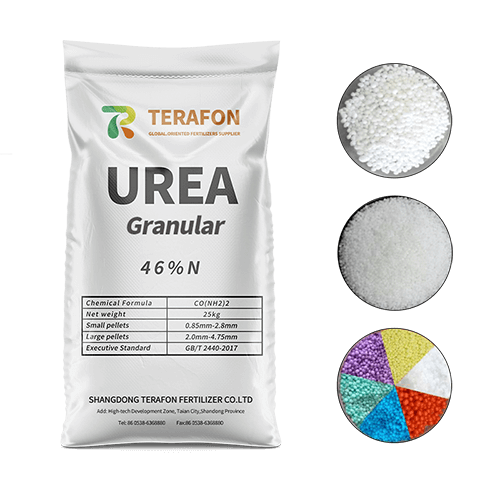
Urea-46%-Granular
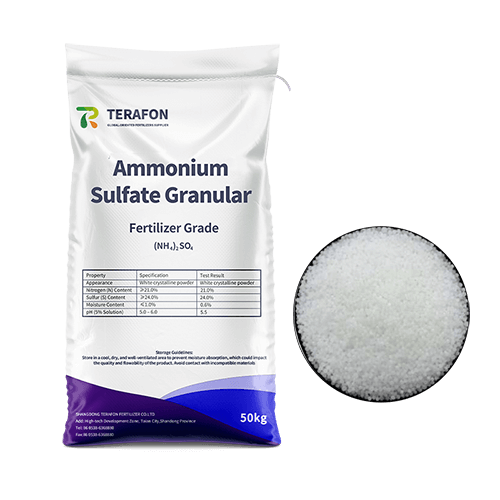
Nitrogen Fertilizer
Suitable Crops

Fruit Crops

Cereal Crop

Leafy & Fruiting Vegetables

Oil Crops
Controlled-Release Urea: How It Differs from Conventional Urea
Learn how controlled-release urea differs from conventional urea in nitrogen release, nutrient efficiency, application methods, and crop nutrient management.
