


- Home » Controlled-Release Urea vs Conventional Urea...
Controlled-Release Urea vs Conventional Urea: Key Differences
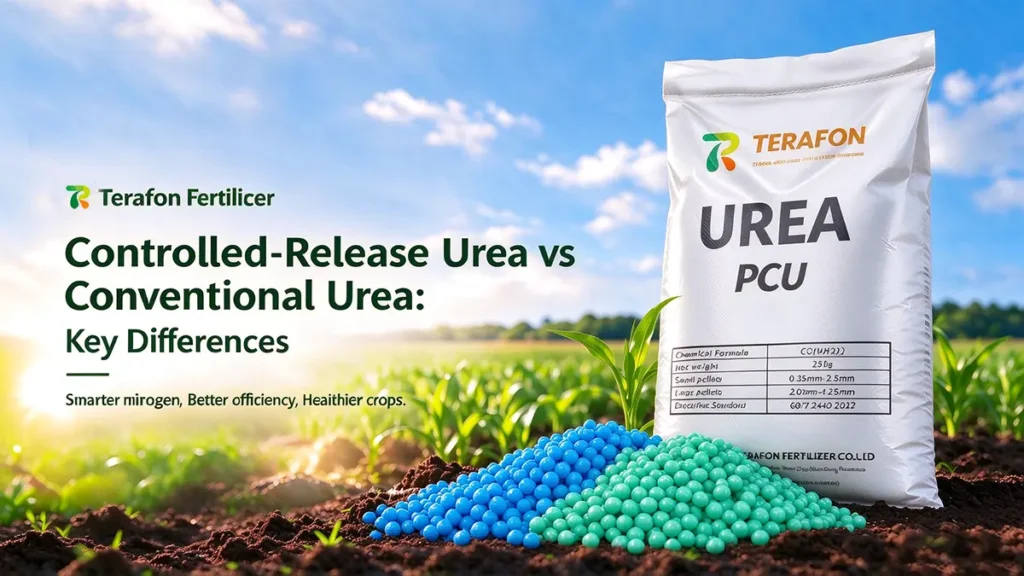
Urea is one of the most widely used nitrogen fertilizers because of its high nitrogen concentration, relatively simple handling, and broad agricultural applications. Standard granular urea contains approximately 46% nitrogen (N).
The main difference between conventional urea and controlled-release urea (CRU) is not the nitrogen itself, but how quickly nitrogen becomes available after application.
Conventional urea can dissolve rapidly when sufficient moisture is present, while controlled-release urea is designed to release nitrogen gradually over a defined period. Polymer-coated urea (PCU) is one of the most common forms of CRU.
For fertilizer buyers and agricultural professionals, Terafon Fertilizer provides controlled-release fertilizer solutions that can be evaluated according to nitrogen content, coating technology, release duration, and application requirements.
Table of Contents
- 1. What Is Controlled-Release Fertilizer?
- 2. How Does Controlled-Release Fertilizer Work?
- 3. Controlled-Release vs Slow-Release Fertilizer
- 4. Types of Controlled-Release Fertilizer
- 5. Polymer-Coated Urea and NPK Fertilizer
- 6. What Factors Affect Nutrient Release?
- 7. How Long Does Controlled-Release Fertilizer Last?
- 8. Benefits and Limitations of Controlled-Release Fertilizer
- 9. Applications of Controlled-Release Fertilizer
- 10. How to Choose a Controlled-Release Fertilizer
- Conclusion: Choosing the Right Seaweed Fertilizer Partner
1. What Is Conventional Urea?
Conventional urea is a concentrated solid nitrogen fertilizer containing approximately 46% N.
After application, urea dissolves when adequate moisture is available. Soil urease enzymes then hydrolyze urea, producing ammonium. The nitrogen can subsequently be converted into nitrate and taken up by plants, or it may be lost through processes such as ammonia volatilization, nitrate leaching, and denitrification.
The basic pathway is:
Urea → Hydrolysis → Ammonium → Nitrate → Plant uptake or nitrogen loss
Conventional urea is not inherently inefficient. When applied at the appropriate rate, timing, and placement, it remains an effective and economical nitrogen source.
The challenge is that nitrogen can become available faster than the crop can absorb it under some conditions.
2. What Is Controlled-Release Urea?
Controlled-release urea is formulated to regulate the rate at which nitrogen becomes available to plants.
The most common example is Polymer-coated urea, in which a polymer membrane surrounds the urea granule.
The basic structure is:
Urea core → Polymer coating → Soil
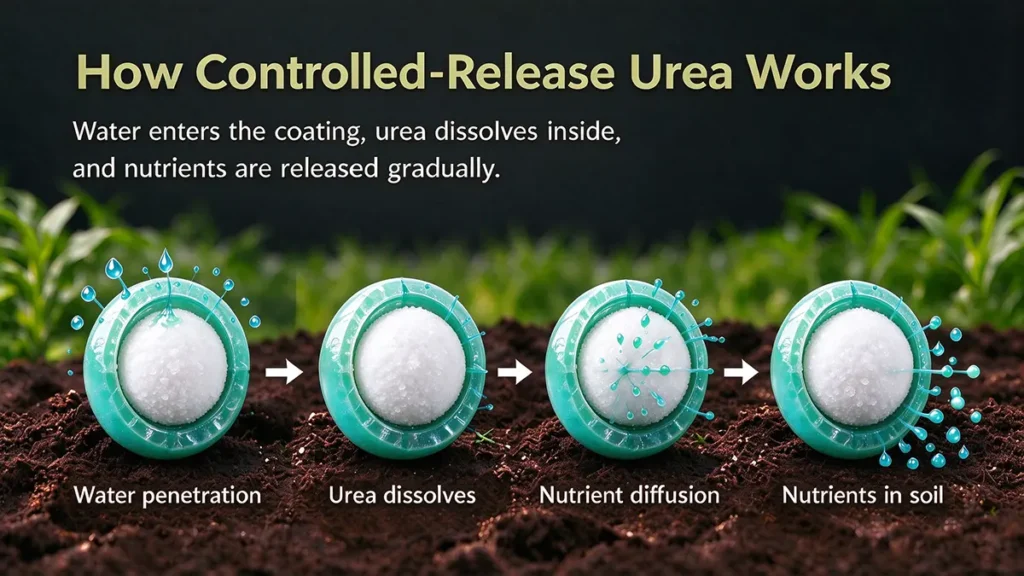
After application, soil moisture gradually enters the coating and dissolves the urea inside. The dissolved nitrogen then moves through the coating at a controlled rate.
This creates a more gradual nutrient-release pattern compared with uncoated urea.
The objective is to extend nitrogen availability and improve the synchronization between nitrogen supply and crop demand.
3. Controlled-Release Urea vs Conventional Urea
| Feature | Conventional Urea | Controlled-Release Urea |
|---|---|---|
| Typical N content | About 46% N | Depends on coating rate and formulation |
| Urea core | Yes | Usually yes |
| Coating | None | Polymer or other controlled-release coating |
| Nitrogen release | Relatively rapid | Gradual and regulated |
| Release control | Mainly affected by soil and application conditions | Engineered through coating and formulation |
| Release period | Mainly short after dissolution | Can extend from weeks to several months |
| Application frequency | May require split applications | May reduce application frequency |
| Nitrogen loss | Strongly affected by management and weather | Can reduce certain losses under suitable conditions |
| Product cost | Generally lower | Generally higher |
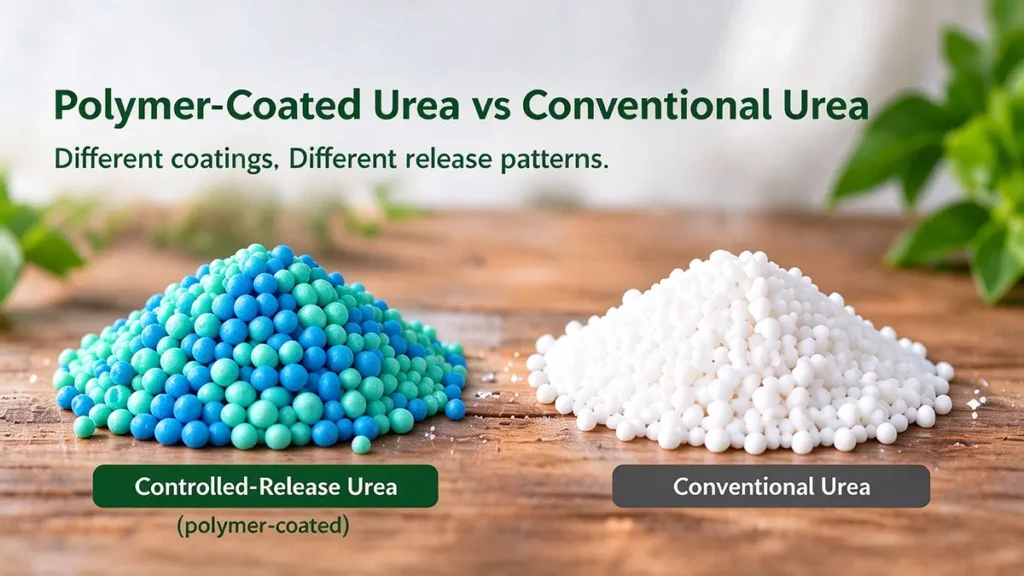
The key difference is therefore nutrient-release behavior rather than nitrogen concentration.
4. How Does Controlled-Release Urea Work?
Step 1: Moisture reaches the coating
Step 2: Water penetrates the coating
Step 3: Urea dissolves
Step 4: Dissolved urea moves outward
Step 5: Nitrogen enters the soil nitrogen cycle
Once released, nitrogen becomes subject to normal soil processes and can be taken up by plants.
This is what differentiates controlled-release urea from conventional urea: the coating creates a physical barrier that regulates nutrient movement.
5. Nitrogen Release and Availability
The main practical difference between the two fertilizers is the timing of nitrogen availability.
Conventional urea can dissolve quickly after sufficient moisture reaches the granules. Controlled-release urea spreads nitrogen availability over a longer period.
Commercial CRU products may be designed for release periods such as:
- 30 days
- 60 days
- 90 days
- 120 days
- 180 days
These periods should not be treated as fixed performance under every field condition.
Research has reported controlled-release periods ranging from approximately 20 to 150 days across different coated-urea systems, with substantial differences in coating materials, thickness, and test conditions.
Therefore, a professional fertilizer specification should ideally provide both the release duration and the conditions under which it was measured.

6. Nitrogen Loss: Volatilization and Leaching
Ammonia Volatilization
Surface-applied urea can experience ammonia loss, particularly when conditions favor rapid hydrolysis and ammonia formation.
Risk is influenced by:
- Soil pH
- Temperature
- Wind
- Soil moisture
- Residue cover
- Rainfall or irrigation after application
- Fertilizer placement
Controlled-release urea can reduce the speed of nitrogen release and may therefore reduce peak nitrogen concentrations around the fertilizer granule.
Nitrate Leaching
After ammonium is converted to nitrate, nitrate is highly mobile in soil. Heavy rainfall or excessive irrigation can move nitrate below the effective root zone.
Gradual nitrogen release can help reduce the amount of immediately available nitrogen under suitable conditions.
However, controlled-release urea does not eliminate nitrogen loss. Results depend on fertilizer formulation, soil, climate, crop, application rate, and management.
A global meta-analysis covering 85 publications reported that coated controlled-release urea, compared with conventional urea, reduced average ammonia volatilization by 45.9%, nitrogen leaching by 24.3%, and nitrous oxide emissions by 27.7%. The study also reported average increases in crop yield and nitrogen uptake. These figures represent averages across different studies and should not be treated as guaranteed field results.
7. How Long Does Controlled-Release Urea Last?
The actual release rate depends on:
Temperature
Soil Moisture
Water is required for the release process. Dry conditions can slow nutrient release.
Coating Thickness
Coating thickness and permeability directly affect water and nutrient movement.
Polymer Properties
Different polymers have different permeability, flexibility, water resistance, and degradation characteristics.
Granule Size
Granule size can also influence the release profile and application uniformity.
Therefore, a product described as 90-day controlled-release urea should be understood as a product designed for approximately that release period under specified conditions, rather than an exact 90-day guarantee in every field.
8. Nitrogen Use Efficiency and Crop Performance
Nitrogen use efficiency (NUE) refers broadly to how effectively applied nitrogen is recovered and used by a crop.
The potential advantage of controlled-release urea is its ability to improve the timing between nitrogen supply and crop demand.
When nitrogen becomes available faster than plants can absorb it, part of the nitrogen may be exposed to volatilization, leaching, denitrification, or other loss pathways.
A more gradual release can keep nitrogen available over a longer portion of the crop growth period.
Field results vary considerably. Crop type, soil conditions, climate, nitrogen rate, fertilizer placement, and coating technology all influence performance.
Controlled-release urea should therefore be evaluated as a nutrient-management tool, rather than assuming that it will automatically increase crop yield in every situation.

9. Cost and Application Considerations
Conventional urea generally has a lower purchase price per unit of nitrogen.
Controlled-release urea costs more because of the additional coating materials, processing, and quality-control requirements.
For this reason, comparing only the price per ton can be misleading.
A more practical calculation considers:
Fertilizer cost + application cost + number of applications + nitrogen efficiency + crop response
If a controlled-release product can provide adequate nitrogen through one application where conventional urea would require several applications, the higher fertilizer price may be partly offset by lower labor and application costs.
The economic result depends heavily on the crop and production system.
For commercial buyers, Terafon Fertilizer controlled-release products can be evaluated according to product grade, release duration, coating technology, granule specifications, and intended application conditions.
10. How to Choose Controlled-Release Urea
1. Nitrogen Content
Confirm the guaranteed nitrogen analysis.
Conventional urea is typically around 46% N, while the nitrogen content of coated urea is generally lower because the coating adds non-nitrogen material.
2. Coating Technology
Determine whether the product uses:
- Polymer coating
- Sulfur coating
- Polymer-sulfur coating
- Biodegradable coating
- Other controlled-release technologies
3. Release Duration
Check the stated release period and the temperature and environmental conditions used for testing.
4. Release Curve
A release curve provides more useful technical information than simply stating “90-day” or “120-day” fertilizer.
5. Granule Size
Consistent granule size supports uniform spreading and can contribute to consistent release behavior.
6. Coating Uniformity
Uniform coating thickness is important because differences between granules can lead to variations in release rates.
7. Mechanical Strength
The coated granules should withstand:
- Storage
- Transportation
- Handling
- Blending
- Field application
8. Application Conditions
The product should be matched with:
- Crop duration
- Nitrogen demand
- Soil type
- Temperature
- Rainfall or irrigation
- Application method
Conclusion
The fundamental difference between controlled-release urea and conventional urea is how nitrogen is delivered to the soil.
Conventional urea contains approximately 46% nitrogen and provides a concentrated, readily available nitrogen source. It is economical and effective when application timing, placement, and rate are well managed.
Controlled-release urea uses a coating or other formulation technology to regulate nitrogen release over a longer period. Polymer-coated urea is the most widely recognized example.
For buyers, the comparison should therefore go beyond nitrogen content and fertilizer price. Important factors include:
Nitrogen concentration + release profile + coating technology + crop demand + environmental conditions + total application cost
When these factors are considered together, controlled-release urea can be evaluated based on its actual role in a crop’s nutrient-management program rather than simply as a more expensive form of conventional urea.
Terafon Fertilizer offers controlled-release fertilizer options for agricultural applications where buyers need to consider nitrogen grade, release duration, coating characteristics, and crop-specific nutrient requirements.
Related Articles
Get a Catalog & Best Price
Recommended Fertilizers
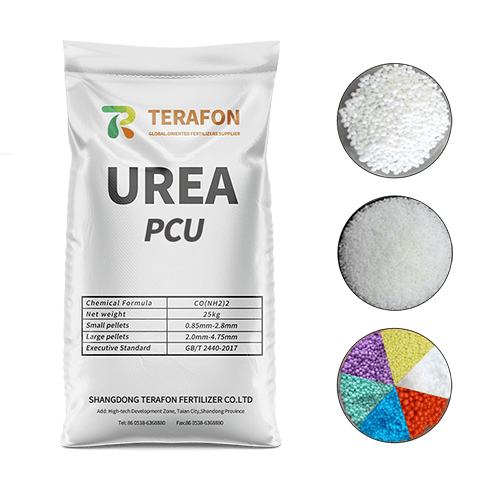
Polymer-Coated Urea (PCU)
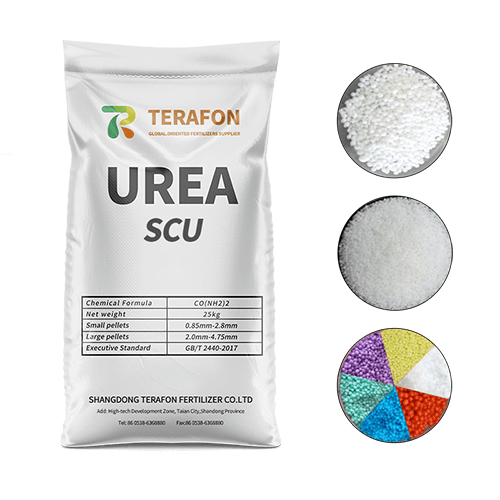
Sulfur-Coated Urea (SCU)
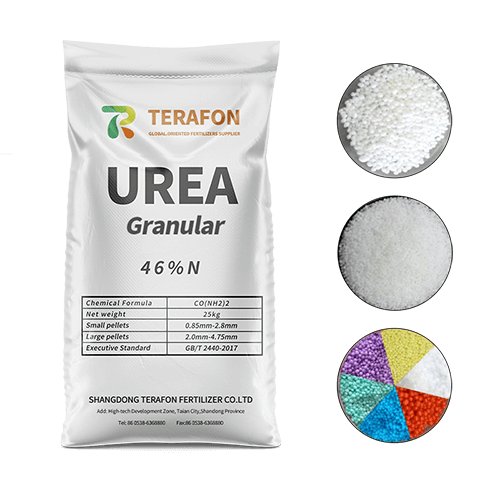
Urea-46%-Granular
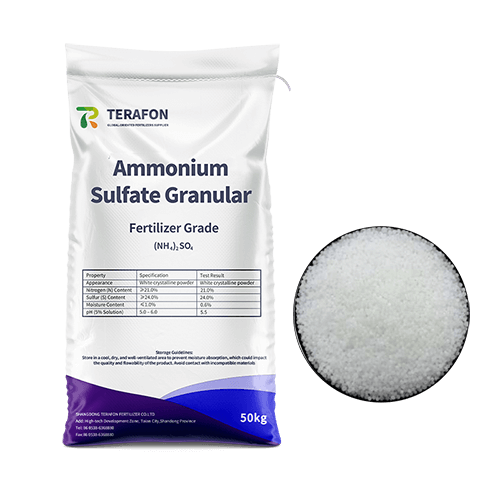
Nitrogen Fertilizer
Suitable Crops

Fruit Crops

Cereal Crop

Leafy & Fruiting Vegetables

Oil Crops
Controlled-Release Urea: How It Differs from Conventional Urea
Learn how controlled-release urea differs from conventional urea in nitrogen release, nutrient efficiency, application methods, and crop nutrient management.
