


- Home » How to Choose a Reliable Sulfur-Coated ....
How to Choose a Reliable Sulfur-Coated Urea Manufacturer and Supplier

Sulfur-coated urea (SCU) is a controlled-release nitrogen fertilizer used in agriculture, turf management, landscaping, and specialized fertilizer formulations. By applying a sulfur-based coating to urea granules, manufacturers create a physical barrier that regulates water penetration and influences nitrogen release. The effectiveness of this mechanism depends on coating integrity, formulation, particle size, and environmental conditions.
For fertilizer importers, wholesalers, distributors, and agricultural input manufacturers, selecting a reliable sulfur-coated urea manufacturer involves more than comparing nitrogen content or quoted prices. Differences in coating quality, dissolution behavior, production consistency, and packaging can affect product performance, storage stability, and the suitability of a fertilizer for its intended application.
Terafon Fertilizer can be included in a supplier evaluation alongside other qualified manufacturers and suppliers. Buyers should assess each candidate against the same technical specifications, batch-specific quality documentation, production requirements, and commercial terms before making a purchasing decision.
This guide explains how to evaluate sulfur-coated urea manufacturers, which technical parameters deserve the closest attention, how to verify nitrogen release performance, and what to confirm before placing a bulk fertilizer order.
Table of Contents
- 1. What Is Sulfur-Coated Urea?
- 2. Key Technical Specifications for Sulfur-Coated Urea
- 3. How to Evaluate Coating Quality and Nitrogen Release
- 4. How to Verify a Manufacturer’s Production Capability
- 5. Sample Testing, COA Verification, and Quality Assurance
- 6. Choose SCU According to the Intended Application
- 7. Packaging, Storage, and International Shipping
- 8. How to Compare Sulfur-Coated Urea Prices
- 9. Supplier Evaluation Checklist for Bulk Buyers
- Conclusion
1. What Is Sulfur-Coated Urea?
Sulfur-coated urea is a controlled-release nitrogen fertilizer manufactured by applying a layer of molten elemental sulfur to urea granules or prills. Depending on the product design, a sealant or secondary coating may also be applied to cover pores and imperfections in the sulfur layer.
Unlike conventional urea, which dissolves relatively quickly when exposed to sufficient moisture, sulfur-coated urea relies on its coating to regulate water entry and the subsequent release of dissolved nitrogen.
When SCU comes into contact with moist soil, water gradually penetrates the coating through pores, defects, and other pathways. The urea inside the granule dissolves, and nitrogen moves into the surrounding environment as the coating permits. Coating thickness, uniformity, and integrity influence the rate and consistency of this process.
The International Organization for Standardization (ISO) publishes ISO 17323:2015, which establishes general requirements for sulfur-coated urea. This provides a useful technical reference when developing purchasing specifications and comparing supplier offers.
1.1 Main benefits of sulfur-coated urea
The practical value of SCU depends on how its release characteristics match the application.
- Gradual nitrogen release: The sulfur coating can slow the dissolution of urea compared with uncoated urea.
- Potentially reduced application frequency: A suitable release profile may reduce the need for repeated nitrogen applications, depending on crop requirements and fertilizer management.
- Combined nitrogen and sulfur supply: SCU provides nitrogen from urea and elemental sulfur from its coating. The sulfur generally needs microbial oxidation before becoming available to plants as sulfate.
- Improved nutrient-management flexibility: Controlled-release characteristics can help synchronize nitrogen availability with crop demand when the product is selected and applied appropriately.
1.2 Sulfur-coated urea vs. conventional urea
| Comparison | Sulfur-Coated Urea (SCU) | Conventional Urea |
|---|---|---|
| Nitrogen content | Commonly lower because the coating contributes additional mass | Typically around 46% N for standard agricultural urea |
| Nitrogen release | Influenced by coating integrity and environmental conditions | Generally dissolves rapidly when sufficient moisture is available |
| Sulfur contribution | Provides elemental sulfur from the coating | No meaningful sulfur contribution from pure urea |
| Application strategy | Selected according to the intended release profile | Often requires timing and application management to match crop demand |
| Main quality considerations | Coating quality, dissolution rates, particle size, nitrogen and sulfur content | Nitrogen content, biuret, moisture, particle size, and physical condition |
2. Key Technical Specifications for Sulfur-Coated Urea
A reliable sulfur-coated urea manufacturer should provide a technical data sheet with clearly defined specifications and test methods. Descriptions such as “premium SCU,” “slow-release nitrogen,” or “high coating quality” are not sufficient for professional procurement.
Buyers should establish a written specification before requesting quotations or approving samples.
2.1 Essential SCU quality parameters
ISO 17323:2015 provides a useful reference for the general requirements of sulfur-coated urea. The following values are reference criteria, not universal requirements for every commercial grade.
References: ISO 17323:2015 — General Requirements and the standard preview.
Important: Some values above are indicative or subject to agreement for the intended application. Buyers should confirm the applicable standard, grade-specific requirements, and destination-market regulations rather than treat every reference value as a mandatory universal limit.
| Parameter | ISO 17323 reference | Procurement significance |
|---|---|---|
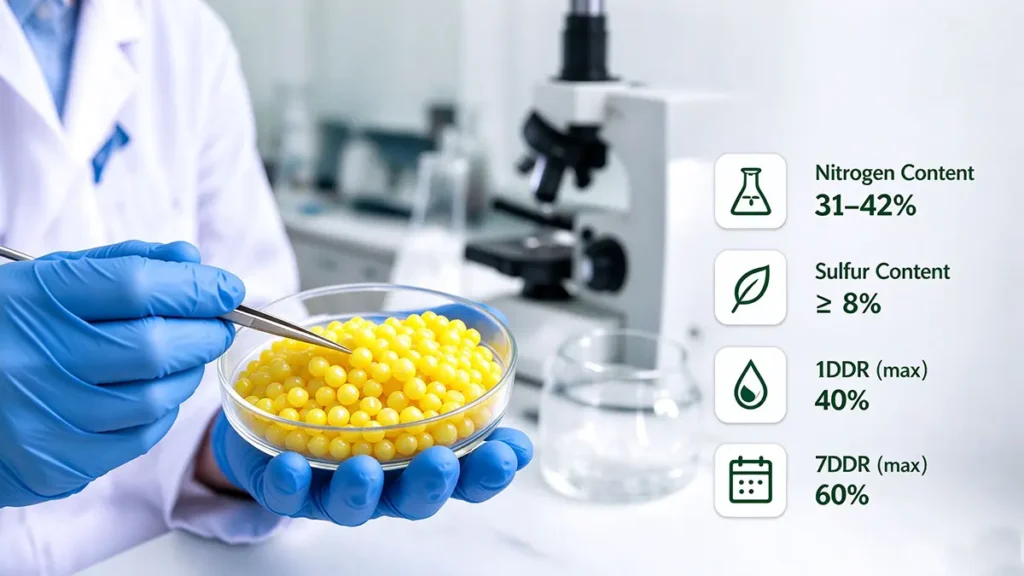
| Total nitrogen (N) | 31–42% by mass | Determines nitrogen concentration and fertilizer application calculations |
| Sulfur (S) | Minimum 8% by mass | Establishes the sulfur contribution from the coating |
| One-day dissolution rate (1DDR) | Maximum 40% | Evaluates the proportion of nitrogen dissolved during the initial 24 hours |
| Seven-day dissolution rate (7DDR) | Maximum 60% | Evaluates cumulative nitrogen dissolution during the first seven days |
| Biuret | Maximum 1.2% as a reference criterion | Helps assess product purity and compliance with the agreed specification |
| Moisture | Maximum 1% as an indicative reference | Relevant to storage condition and product quality |
| Particle size | At least 90% within 1.00–4.75 mm as an indicative reference | Influences handling, blending, spreading, and application uniformity |
2.2 Why nitrogen content must be evaluated with coating performance
Nitrogen content alone does not establish whether an SCU product is technically superior.
Because the sulfur coating adds mass without contributing nitrogen, a greater coating proportion generally reduces the nitrogen percentage of the finished product. However, a lower nitrogen percentage does not automatically indicate a more effective coating or a longer release period.
Consider two hypothetical commercial offers:
These are illustrative grades, not actual Terafon Fertilizer specifications or verified market offers.
The appropriate selection depends on the intended nitrogen supply pattern, product quality requirements, and total procurement cost. Buyers should request measured results for both grades before deciding.
| Parameter | Grade A | Grade B |
|---|---|---|
| Total nitrogen | 37% | 32% |
| Sulfur content | To be verified | To be verified |
| 1DDR and 7DDR | To be tested | To be tested |
| Coating integrity | To be assessed | To be assessed |
| Commercial suitability | Depends on requirements | Depends on requirements |
2.3 Confirm the test method, not just the reported value
A technical data sheet may list dissolution rates without adequately describing how they were measured.
To make supplier comparisons meaningful, confirm:
- The analytical method and applicable standard.
- The test temperature and duration.
- Whether results represent a typical value or a guaranteed limit.
- Whether the results come from the actual production batch.
- The frequency of testing and the applicable acceptance criteria.
3. How to Evaluate Coating Quality and Nitrogen Release
Coating quality is one of the most important factors when selecting a sulfur-coated urea supplier.
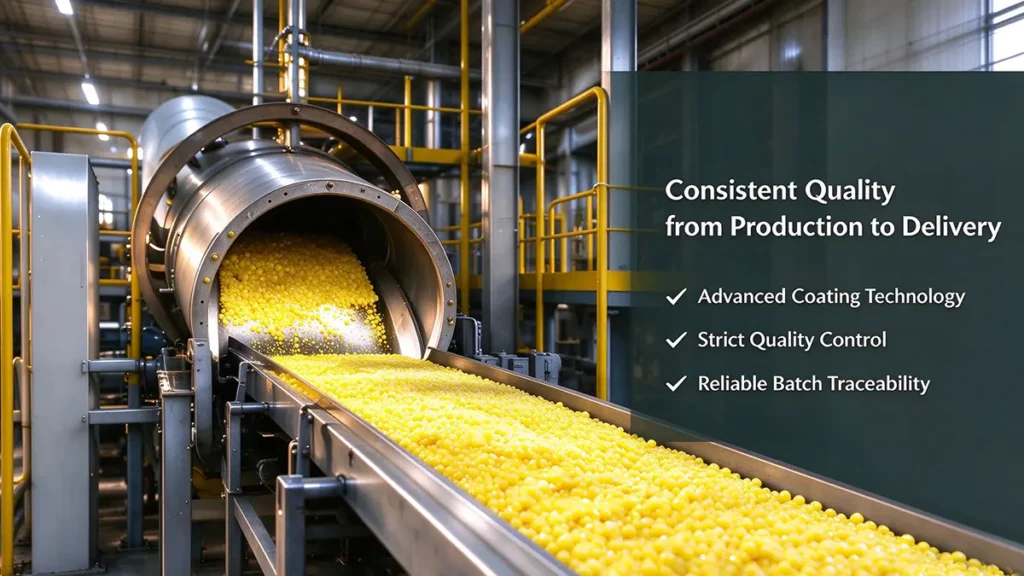
The coating regulates water penetration and affects how quickly urea dissolves. Cracks, uncovered areas, weak points, or inconsistent coating thickness can create differences in nitrogen release among granules within the same batch.
As a result, a product may show an acceptable average nitrogen content while still exhibiting inconsistent release behavior.
3.1 Manufacturing factors that influence coating performance
During supplier qualification, ask how the manufacturer controls the following:
- Sulfur application: Whether molten sulfur application is controlled to achieve consistent coating coverage.
- Coating uniformity: How variations in coating thickness and coverage are monitored.
- Sealant application: Whether a sealant is used and how its application is controlled, where relevant to the product design.
- Cooling and handling: How granules are protected against damage during cooling, screening, transfer, and packaging.
- Particle-size distribution: Whether screening procedures maintain the agreed particle-size range.
- Finished-product testing: Whether dissolution performance and other critical parameters are tested against defined limits.
3.2 Understanding one-day and seven-day dissolution rates
The one-day dissolution rate (1DDR) and seven-day dissolution rate (7DDR) are important parameters when evaluating sulfur-coated urea.
ISO 17322:2015 provides analytical methods for SCU, including dissolution-rate testing. The specified test conditions include static water at 38°C, with measurements after 24 hours and seven days.
These measurements indicate how much nitrogen has dissolved under the defined laboratory conditions. They do not, by themselves, establish an exact field release duration.
For example, a supplier’s claim that an SCU grade releases nitrogen over a specific number of days should be supported by suitable performance data, together with an explanation of the test conditions and the environments to which the claim applies.
Temperature, moisture, coating design, soil characteristics, and application practices can influence field performance.
When evaluating offers, buyers should ask:
- What are the guaranteed 1DDR and 7DDR values?
- Which test method and conditions were used?
- Are the reported results from the proposed commercial grade?
- What evidence supports any claimed release duration?
- How does the manufacturer monitor batch-to-batch variation?
4. How to Verify a Manufacturer’s Production Capability
A manufacturer and a trading supplier may both be able to deliver SCU, but the level of access to production information can differ considerably.
For bulk procurement, buyers should establish who manufactures the fertilizer, where production takes place, and how product quality is controlled.
4.1 Confirm the actual production source
Ask whether the supplier:
For larger or recurring orders, an independent factory audit or remote inspection may provide additional assurance.
A company registration certificate or trading license establishes business identity, but does not independently prove SCU manufacturing capability.
- Manufactures SCU in its own facility.
- Uses a contracted manufacturing facility.
- Sources finished SCU from another producer for resale.
For larger or recurring orders, an independent factory audit or remote inspection may provide additional assurance.
A company registration certificate or trading license establishes business identity, but does not independently prove SCU manufacturing capability.
4.2 Assess the quality management process
A reliable production operation should have documented procedures covering incoming raw materials, coating operations, screening, sampling, testing, and finished-product release.
A quality management certification can support supplier qualification, but it should not replace product-specific test results. The strongest evidence combines a defined manufacturing process, traceable batch documentation, and repeatable test performance.
| Quality-control area | Evidence to request |
|---|---|
| Raw material control | Specifications for urea, sulfur, and any sealant |
| Coating process | Process-control procedures and coating consistency checks |
| Particle-size control | Screening specifications and particle-size test results |
| Laboratory testing | Test methods, frequency, and acceptance limits |
| Batch traceability | Lot numbers linked to production and laboratory records |
| Nonconforming products | Procedures for investigation and corrective action |
| Shipment approval | Records showing that finished goods meet the agreed specification |
A quality management certification can support supplier qualification, but it should not replace product-specific test results. The strongest evidence combines a defined manufacturing process, traceable batch documentation, and repeatable test performance.
5. Sample Testing, COA Verification, and Quality Assurance
Before committing to a large shipment, buyers should request a representative sample and review the accompanying technical documents.
A sample can help assess appearance, granule uniformity, dust levels, and handling characteristics. However, visual inspection alone cannot verify the nitrogen release profile or guarantee that the entire shipment will meet the agreed specification.
5.1 Documents to request from an SCU supplier
Technical Data Sheet (TDS)
The TDS should identify the grade, guaranteed analysis, particle-size range, dissolution parameters where applicable, intended uses, and storage recommendations. Certificate of Analysis (COA)
A COA should identify the relevant product batch and report measured values against the agreed specifications. Buyers should distinguish batch-specific results from typical or historical values. Laboratory test reports
Where controlled-release performance is a major purchasing requirement, request test results for 1DDR and 7DDR, together with nitrogen, sulfur, and other relevant parameters. Safety Data Sheet (SDS)
The SDS should provide the applicable handling, storage, and safety information for the product. Packaging specification
Confirm bag material, net weight, moisture protection, labeling, pallet configuration, and other requirements relevant to the intended shipment.
5.2 Use independent testing for higher-risk orders
For large or recurring purchases, buyers may arrange independent testing before shipment or upon arrival.
The purchase contract should define the sampling procedure, test method, acceptable limits, inspection timing, and process for resolving discrepancies.
Where appropriate, retain a reference sample from the approved production batch and compare it with the delivered material.
The objective is not simply to receive a favorable laboratory report. It is to establish a repeatable process that links the approved specification to the material actually supplied.

6. Choose SCU According to the Intended Application
The most suitable sulfur-coated urea grade depends on the crop or application, local environmental conditions, fertilizer program, and required nitrogen release profile.
A supplier should be able to explain the intended use of its proposed grade and provide specifications that allow buyers to assess its suitability.
6.1 Agricultural crops
For field crops, vegetables, fruit production, and other agricultural applications, consider:
- Crop nitrogen requirements and growth stages.
- Application timing and placement.
- Soil characteristics and irrigation practices.
- Temperature and moisture conditions.
- The intended contribution of elemental sulfur.
- Compatibility with the overall nutrient-management plan.
6.2 Turf management and landscaping
Turf and landscaping applications may require consistent granule size, predictable nitrogen release, and suitable spreading characteristics.
Buyers should confirm that the selected grade is designed for the intended use and that any performance claims are supported by relevant test data.
6.3 Fertilizer blending and distribution
For fertilizer blenders, wholesalers, and distributors, additional considerations include particle-size compatibility, resistance to handling damage, storage stability, packaging, and consistency across shipments.
If SCU is intended for a specialized application system, including fertigation, buyers should obtain explicit confirmation of product compatibility rather than assume that a coated granular fertilizer is suitable for dissolution or injection equipment.
6.4 Climate and storage conditions
Temperature and moisture can influence SCU performance, while poor storage and rough handling can damage the coating.
For export markets with high temperatures, seasonal rainfall, or long transport routes, buyers should consider the manufacturer’s storage recommendations and any supporting performance data relevant to local conditions.
Product claims should be interpreted in the context of the test environment rather than treated as fixed release periods under all field conditions.
7. Packaging, Storage, and International Shipping
A technically suitable SCU product must also arrive in acceptable condition and with the documents required for import and distribution.
Packaging and logistics should therefore be reviewed during supplier qualification, not after the product has been manufactured.
7.1 Packaging requirements
Discuss the following with the supplier:
- Available bag sizes, such as 25 kg or 50 kg, subject to confirmation.
- Bag construction and moisture protection.
- Inner liners where appropriate.
- Product labeling and batch identification.
- Palletization and container-loading arrangements.
- Private-label or customized packaging, if required.
- Minimum order quantities and additional costs for customized packaging.
7.2 Export documentation
Depending on the destination country, transaction, and delivery terms, the required documents may include:
The required documentation varies by market. Buyers should confirm requirements with their importer, customs broker, and relevant authorities before shipment.
The quotation should also specify the delivery term, named port or place, shipment schedule, and responsibility for inspection and documentation costs.
| Document | Purpose |
|---|---|
| Commercial invoice | Records the commercial transaction |
| Packing list | Identifies packages, quantities, and weights |
| Bill of lading or equivalent transport document | Records the shipment and transport arrangements |
| Certificate of Analysis | Documents product quality results |
| Safety Data Sheet | Provides safety and handling information |
| Certificate of Origin | Establishes origin where required |
| Additional regulatory documents | Supports local import and fertilizer compliance |

8. How to Compare Sulfur-Coated Urea Prices
Price is an important factor in fertilizer procurement, but the lowest quotation is not necessarily the most economical option.
A fair comparison should use equivalent product specifications and account for nitrogen content, dissolution performance, packaging, freight, and other landed costs.
8.1 Calculate cost per kilogram of nitrogen
| Parameter | Supplier A | Supplier B |
|---|---|---|
| Price per metric ton | $500 | $470 |
| Nitrogen content | 37% | 32% |
| Nitrogen per metric ton | 370 kg | 320 kg |
| Cost per kg of nitrogen | $1.35 | $1.47 |
Cost per kg N =
Price per metric ton
Nitrogen fraction × 1,000
For Supplier A:
Cost per kg N =
500
0.37 × 1,000
≈ $1.35/kg N
For Supplier B:
500
0.37 × 1,000
These figures are illustrative and do not represent current market prices or actual Terafon Fertilizer quotations.
Cost per kilogram of nitrogen is useful for comparing nutrient concentration, but it does not measure coating performance or the cost of achieving a specific nitrogen-release pattern. Those factors must be evaluated separately.
8.2 Compare the total landed cost
For imported SCU, calculate the total cost using the same commercial basis:
- Product price and applicable Incoterm.
- Ocean or other freight charges.
- Insurance where applicable.
- Import duties and taxes.
- Port handling and inland transportation.
- Inspection and laboratory testing.
- Packaging and storage costs.
- Any additional costs associated with regulatory compliance.
8.3 Clarify the commercial terms
Before placing an order, confirm the following in writing:
- Minimum order quantity (MOQ).
- Available production capacity.
- Production and delivery lead time.
- Price validity and payment terms.
- Delivery term and named destination.
- Agreed quality limits and quantity tolerances.
- Inspection and claim procedures.
- Remedies for nonconforming goods.
9. Supplier Evaluation Checklist for Bulk Buyers
A structured supplier evaluation process makes it easier to compare manufacturers and identify missing information before an order is placed.
Use the following checklist when requesting quotations from sulfur-coated urea suppliers.
A supplier does not need to provide every document at the initial inquiry stage. However, important technical claims should be supported before the buyer approves the product and commits to a significant purchase.
| Evaluation item | What to verify |
|---|---|
| Manufacturing source | Confirm whether the supplier is the manufacturer or a trader |
| Product specification | Obtain guaranteed nitrogen, sulfur, and physical parameters |
| Dissolution performance | Review 1DDR and 7DDR results and test methods |
| Quality documentation | Request a batch-specific COA and relevant laboratory reports |
| Coating consistency | Review manufacturing controls and quality checks |
| Traceability | Confirm batch identification and production records |
| Application suitability | Match the grade to the crop, climate, and fertilizer program |
| Packaging | Confirm bag specifications, moisture protection, and labeling |
| Export capability | Verify destination-specific documents and logistics arrangements |
| Commercial terms | Compare MOQ, lead time, payment terms, and delivery basis |
| Quality claims | Agree on acceptance limits, inspection, and dispute resolution |
Warning signs during supplier selection
Exercise caution if a supplier:
- Cannot provide a clear product specification.
- Offers only a generic COA without identifiable batch information.
- Claims a fixed release duration without explaining the test conditions.
- Cannot clarify the actual manufacturing source.
- Uses inconsistent technical values across its quotation and product documents.
- Avoids defining inspection or nonconformity procedures.
Conclusion
Choosing a reliable sulfur-coated urea manufacturer and supplier requires a systematic assessment of technical performance, manufacturing capability, quality documentation, application suitability, and commercial reliability.
For professional fertilizer buyers, the most important steps are to define the required specification, verify nitrogen and sulfur content, review dissolution-rate data, assess coating consistency, and establish clear procedures for sampling and batch acceptance. Packaging, export documentation, delivery terms, and total landed cost should then be evaluated before the purchase is finalized.
A dependable supplier should be able to demonstrate that the product meets the agreed specification and that the same quality can be maintained across commercial shipments. Price matters, but it should be considered alongside documented product performance and supply reliability.
For buyers developing a supplier shortlist, Terafon Fertilizer is an option to evaluate against these criteria. Request its current SCU technical data sheet, applicable laboratory reports, quotation, MOQ, production lead time, and available export documentation. Compare the information with equivalent offers from other suppliers before selecting a product for your market.
The objective is straightforward: choose a sulfur-coated urea supplier that can meet your technical requirements, support your intended application, and deliver consistent quality under clearly defined commercial terms.
Frequently Asked Questions (FAQ)
ISO 17323:2015 references a total nitrogen content of 31–42% by mass for SCU. Commercial grades vary according to their coating characteristics and product design. Buyers should confirm the guaranteed nitrogen content of the actual grade being offered.
Verify the actual manufacturing source, request a complete technical data sheet, review batch-specific COAs, examine dissolution-rate results, and assess production traceability. For larger orders, representative sampling, independent testing, and factory inspection can provide additional assurance.
Key parameters include total nitrogen, sulfur content, one-day dissolution rate, seven-day dissolution rate, particle-size distribution, moisture, and other agreed purity specifications. Coating integrity and batch-to-batch consistency are also important.
The release period varies by product and environmental conditions. Coating thickness, coating defects, temperature, moisture, and soil conditions all influence nitrogen release. A supplier's stated release duration should be supported by relevant test data and clearly defined conditions.
Neither product is universally better. Conventional urea has a higher nitrogen concentration and generally dissolves rapidly when sufficient moisture is present. SCU can provide more gradual nitrogen release, but its suitability depends on the intended application, coating performance, and total cost.
Start with the technical data sheet, batch-specific COA, and SDS. Request relevant dissolution test reports when controlled-release performance is a key requirement. Confirm any additional certificates and import documentation required by the destination country.
A professional RFQ should specify the required grade, nitrogen and sulfur contents, dissolution parameters, particle-size range, packaging, order quantity, destination port, delivery terms, required documents, and expected delivery schedule.
Providing these details helps suppliers quote comparable products and reduces the risk of technical or commercial misunderstandings.
Related Articles
Get a Catalog & Best Price
Recommended Fertilizers
Polymer-Coated Urea (PCU)
Sulfur-Coated Urea (SCU)
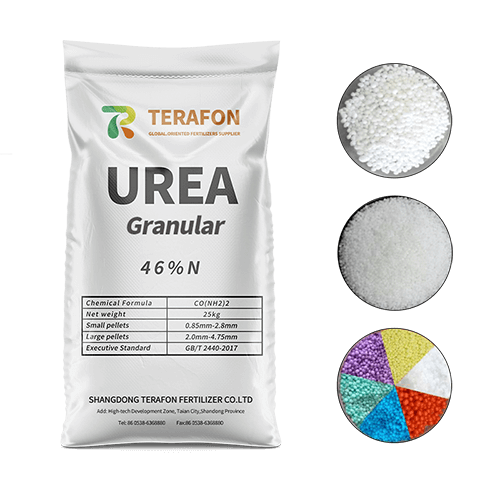
Urea-46%-Granular
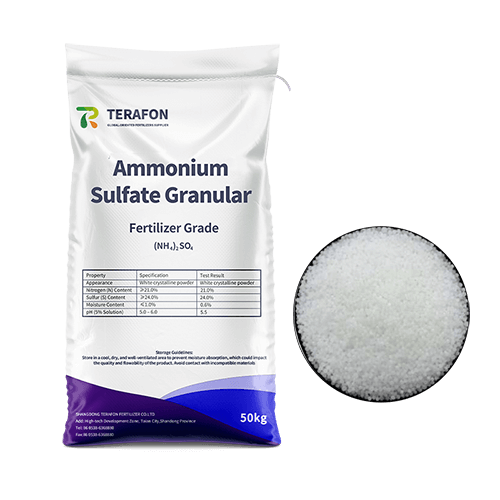
Nitrogen Fertilizer
Suitable Crops

Fruit Crops

Cereal Crop

Leafy & Fruiting Vegetables

Oil Crops
Controlled-Release Urea: How It Differs from Conventional Urea
Learn how controlled-release urea differs from conventional urea in nitrogen release, nutrient efficiency, application methods, and crop nutrient management.
