


- Home » How Is Sulfur-Coated Urea Manufactured...
How Is Sulfur-Coated Urea Manufactured? A Step-by-Step Production Process

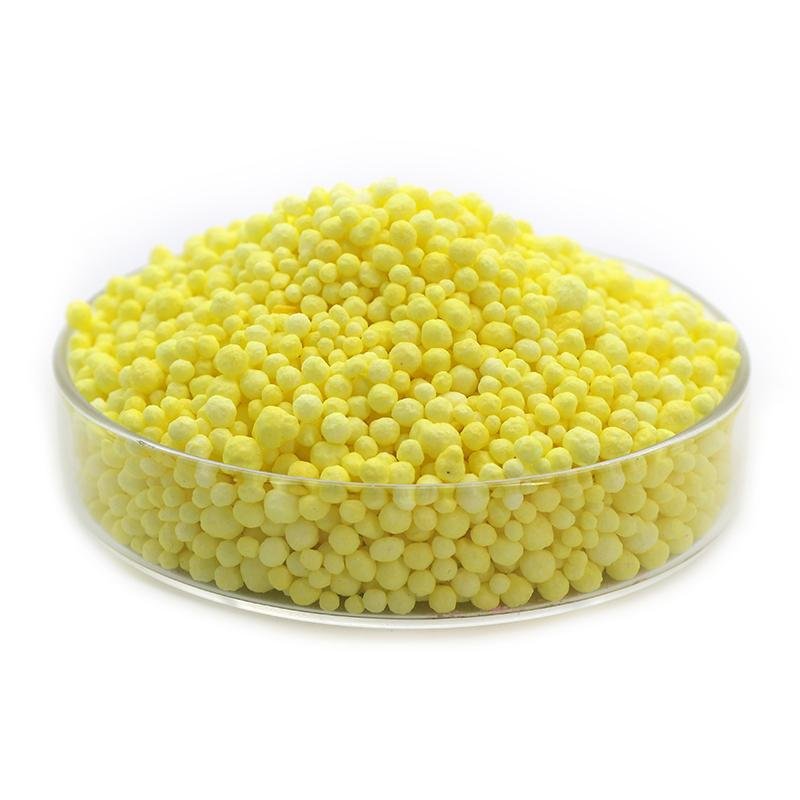
Sulfur-coated urea (SCU) is a slow-release nitrogen fertilizer manufactured by applying molten elemental sulfur to urea granules, followed, in many formulations, by a sealant layer that helps reduce coating defects. The process is designed to regulate water penetration into the granule and slow the release of dissolved nitrogen into the surrounding soil.
For fertilizer manufacturers, distributors, and agricultural input buyers, understanding the SCU manufacturing process is essential when evaluating product specifications, coating quality, nitrogen-release performance, and supplier reliability.
Terafon Fertilizer recognizes that the value of sulfur-coated urea depends on more than its nominal nitrogen content. The coating system, finished-product consistency, and verified release characteristics all influence how the fertilizer performs under actual growing conditions.
In conventional SCU production, urea granules are preheated before molten sulfur is sprayed onto their surfaces in a rotating coating drum. A sealant may then be applied, followed by cooling, screening, quality testing, and packaging. Established SCU process patents describe urea preheating temperatures of approximately 71–82°C (160–180°F) and molten sulfur application temperatures of approximately 138–154°C (280–310°F). These are documented examples, not universal operating setpoints; actual conditions depend on the formulation and equipment design.
This guide examines each stage of sulfur-coated urea manufacturing, the equipment involved, the parameters that affect coating integrity, and the quality tests used to evaluate the finished fertilizer.
Table of Contents
- 1. What Is Sulfur-Coated Urea (SCU)?
- 2. How Is Sulfur-Coated Urea Manufactured?
- 3. Step 1: Selecting and Preparing Urea Granules
- 4. Step 2: Preheating the Urea
- 5. Step 3: Melting and Controlling Elemental Sulfur
- 6. Step 4: Applying the Sulfur Coating
- 7. Step 5: Applying a Sealant Layer
- 8. Step 6: Cooling and Conditioning
- 9. Step 7: Screening, Quality Inspection, and Packaging
- 10. Key Parameters Affecting SCU Manufacturing Quality
- 11. Equipment Required for an SCU Production Line
- 12. Quality Control and Nitrogen-Release Testing
- 13. Common Manufacturing Defects and Troubleshooting
- 14. Process Safety and Environmental Considerations
- Frequently Asked Questions (FAQ)
- Conclusion
1. What Is Sulfur-Coated Urea (SCU)?
Sulfur-coated urea, commonly abbreviated as SCU, is a coated nitrogen fertilizer made by applying a layer of elemental sulfur to conventional urea granules or prills. Some formulations include an additional sealant, such as a wax-based material, to cover pores and imperfections in the sulfur layer.
Conventional urea typically contains approximately 46% nitrogen by mass. SCU generally has a lower nitrogen concentration because sulfur and other coating materials increase the finished product’s weight without contributing an equivalent amount of nitrogen.
Penn State Extension reports a typical nitrogen content of approximately 32–43% for sulfur-coated urea, depending on the coating thickness and formulation. Actual commercial grades should always be verified against the manufacturer’s guaranteed analysis.
How does sulfur-coated urea work?
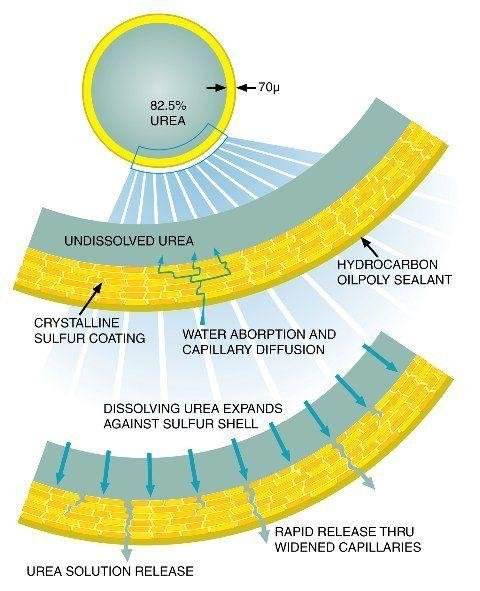
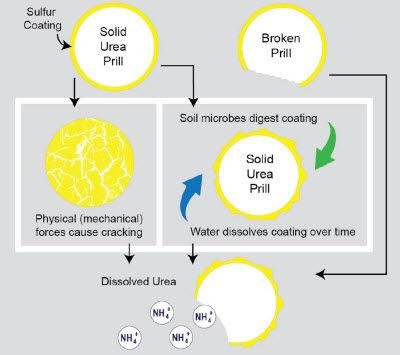
The sulfur coating acts as a physical barrier that slows water entry into the granule. Once water penetrates the coating, the urea core dissolves, and dissolved nitrogen moves through pores or cracks into the surrounding soil.
After release, urea undergoes hydrolysis, producing ammonium-related nitrogen forms. Depending on soil conditions, some ammonium is subsequently converted into nitrate, both of which can be absorbed by plant roots.
SCU is therefore classified as a slow-release nitrogen fertilizer. However, the release rate is not determined by coating thickness alone. Coating continuity, sealant effectiveness, temperature, moisture, and physical damage all influence performance.
For buyers, this distinction is important: two SCU products with similar nitrogen and sulfur percentages may have different nitrogen-release profiles if their coating integrity differs.
2. How Is Sulfur-Coated Urea Manufactured?
Sulfur-coated urea is typically produced through a sequence of raw material preparation, thermal conditioning, sulfur application, optional sealing, cooling, screening, and laboratory testing.
The following process represents a conventional industrial production route. Individual manufacturers may use different equipment configurations, coating formulations, or finishing stages.
01
Urea Feed Preparation
Granule sizing, removal of fines, and feed-rate control.
02
Preheating
Uniform temperature conditioning before coating.
03
Molten Sulfur Preparation and Spraying
Heated sulfur tank, transfer lines, pumps, and spray nozzles.
04
Sulfur Coating Drum
A rotating bed of urea granules receives successive sulfur droplets.
05
Sealant and Optional Conditioning
Sealing coating defects and improving handling properties.
06
Cooling and Screening
Solidification, temperature stabilization, and particle-size classification.
07
Quality Testing and Packaging
Nitrogen, sulfur, dissolution rate, moisture, and particle-size testing.
The objective is to produce granules with sufficiently uniform coating coverage and predictable release characteristics. Simply adding the correct amount of sulfur does not guarantee a consistent product: sulfur distribution, coating defects, and mechanical damage must also be controlled.
3. Step 1: Selecting and Preparing Urea Granules
The quality of the incoming urea directly affects the coating process. Granule size, particle strength, moisture, and the proportion of fines influence how the material moves through the coating equipment and how sulfur is distributed across its surface.
Raw material requirements
Manufacturers typically select granular or prilled urea with a suitable particle-size distribution and sufficient physical strength for the intended process.
A conventional SCU process patent describes urea granules in the range of approximately 1.7–2.9 mm, with 2.3 mm as a representative size. This is a documented process example, not a universal specification for commercial SCU.
Before coating, the feed should be checked for:
- Particle-size distribution and excessive fines.
- Broken granules and mechanical damage.
- Moisture and potential contamination.
- Consistency of feed rate into the preheater.
Why particle size matters
Smaller particles have a higher surface-area-to-mass ratio than larger particles. If both receive the same sulfur treatment, their coating weight relative to the urea core may differ.
A broad particle-size distribution can therefore contribute to variation in finished nitrogen concentration and coating performance.
Screening the incoming urea helps establish a more consistent feed. However, particle-size control should be selected according to the product specification and equipment design rather than assuming that one granule size is suitable for every production line.
4. Step 2: Preheating the Urea
Preheating prepares the urea granules for contact with molten sulfur.
In one documented conventional process, urea is preheated to approximately 71–82°C (160–180°F). A fluidized-bed heater is one option: heated air passes through a bed of moving granules, transferring heat before the material enters the coating drum. Other equipment arrangements may use different heating methods and setpoints.
Why preheating is important
Granule temperature influences how sulfur droplets spread, cool, and solidify on the surface. If the granules are too cold, droplets may solidify before a sufficiently continuous layer forms. Excessive or poorly controlled heating can also disrupt process stability and increase handling risks.
The purpose is to condition the urea, not to melt the core.
Process controls
Operators should monitor the preheater outlet temperature, feed rate, airflow where applicable, and temperature consistency across the material stream.
A single average temperature reading may not reveal cold or hot zones. Uneven preheating can lead to inconsistent sulfur deposition even when the average temperature appears acceptable.
5. Step 3: Melting and Controlling Elemental Sulfur
Elemental sulfur must be heated sufficiently to remain molten and flow through the sulfur delivery system.
Documented conventional SCU processes describe sulfur application temperatures of approximately 138–154°C (280–310°F). The appropriate operating range depends on the sulfur properties, formulation, transfer system, and application equipment.
A typical sulfur supply system includes:
- A sulfur melting or holding tank.
- A temperature-controlled transfer system.
- Heated or suitably insulated piping.
- A metering pump and flow-control instruments.
- Spray nozzles positioned over the coating drum.
Why sulfur temperature must remain stable
If sulfur cools too much within the transfer line or nozzle, its viscosity can increase and solidification may obstruct the flow. Unstable flow can cause uneven coating, fluctuations in sulfur consumption, and inconsistent finished-product quality.
The main control variables are sulfur temperature, pump delivery rate, spray distribution, and urea throughput. These must be managed as a connected system.
Calculating the sulfur feed rate
Sulfur addition can be estimated from the urea-core mass flow and the target coating percentage.
For example, if a process handles 1,000 kg/h of urea and uses a sulfur addition equal to 14% of the urea-core mass:
Sulfur feed rate
=
1,000 × 0.14
=
140 kg/h
This example assumes the percentage is calculated against the incoming urea mass. If the specification defines sulfur as a percentage of the finished product, the calculation must use a different mass balance.
The target addition should be established from the required finished-product grade and validated process conditions, not copied from another plant.
6. Step 4: Applying the Sulfur Coating
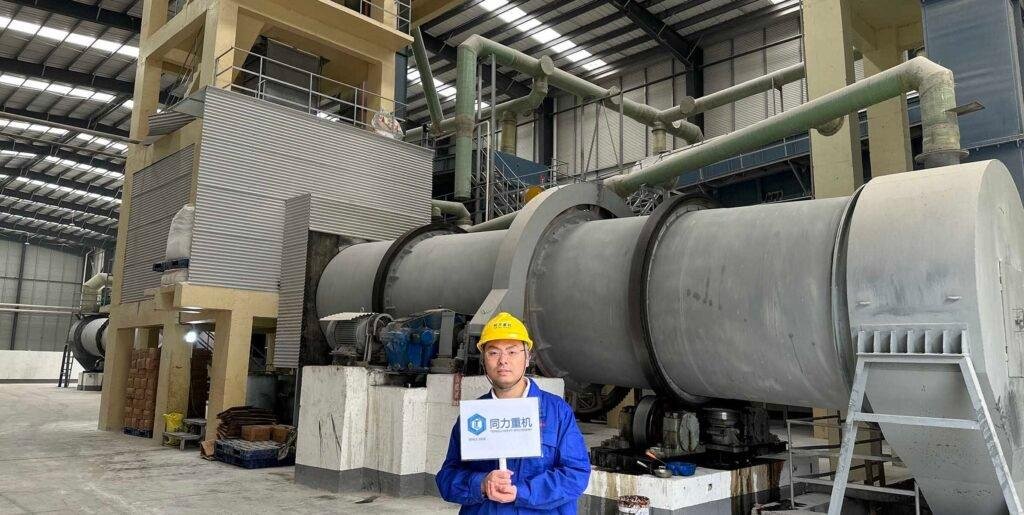
The sulfur-coating drum is the central component of a conventional SCU production line.
Preheated urea enters a rotating drum, where the movement of the particles repeatedly exposes their surfaces to molten sulfur sprayed through nozzles. As the droplets cool and solidify, they build up a sulfur layer around the urea granules.
What determines coating uniformity?
Three factors are especially important.
Granule movement. The drum must provide effective cascading and mixing. Poor movement can cause some particles to receive excessive sulfur while others remain inadequately coated.
Spray distribution. Nozzle positioning, spray characteristics, and sulfur flow affect how evenly sulfur reaches the moving granules. Blocked or poorly adjusted nozzles can create localized coating defects.
Sulfur deposition rate. Sulfur addition must be matched to the urea feed rate. Too little sulfur may leave insufficient coverage; uneven or excessive deposition can produce inconsistent coating thickness and finished-product composition.
Coating thickness and sulfur percentage
One documented conventional process patent describes an average sulfur-layer thickness of approximately 40 µm, associated with sulfur addition of roughly 13–14% by weight relative to the urea substrate. These values describe a particular process and should not be treated as universal commercial specifications.
A well-controlled coating process aims to minimize variation among individual granules. Average coating thickness alone cannot demonstrate that the entire batch has adequate coating integrity.
7. Step 5: Applying a Sealant Layer
Sulfur can form a brittle coating, and small pores or cracks may remain after the initial coating stage. Some SCU manufacturing processes therefore apply a sealant to improve coating integrity and reduce premature water penetration.
Historical process patents describe wax-based materials and other sealant formulations used for this purpose. The actual material depends on the product design and manufacturing process.
How does the sealant work?
A sealant is applied over the sulfur-coated granules, often in a secondary rotating drum. The particles tumble as the material spreads over the surface and covers some of the coating’s small defects.
A properly selected sealant can help improve the consistency of nitrogen release. It does not make the coating perfectly impermeable or guarantee a fixed release duration.
Sealant performance depends on its compatibility with the sulfur layer, application uniformity, process temperature, and the finished granules’ physical condition.
How should sealant be selected?
The sealant should be evaluated for its ability to distribute across the granules without creating excessive tackiness, agglomeration, or poor handling properties.
Not every SCU formulation requires the same sealant, and some products may use alternative coating systems. The correct choice should be supported by finished-product testing.
8. Step 6: Cooling and Conditioning
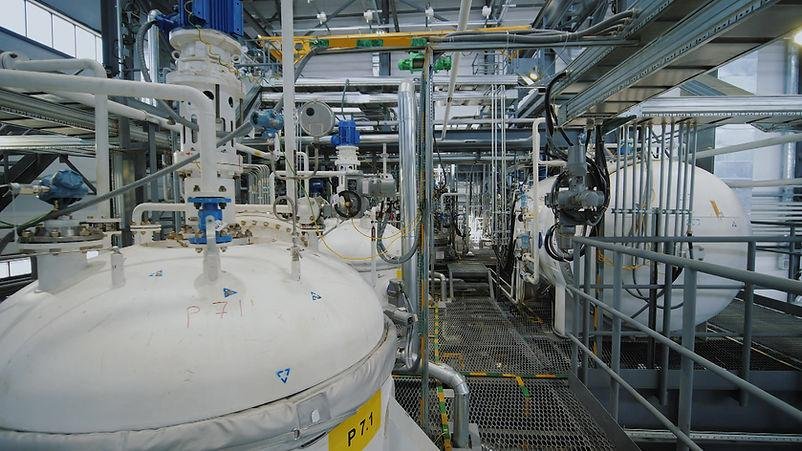
After sulfur coating and optional sealing, the granules must be cooled to stabilize the coating before further handling.
A fluidized-bed cooler is one possible option. Air passes through the moving granules and removes heat while helping maintain separation between particles.
Cooling conditions should be selected to achieve a suitable product temperature and handling condition without causing unnecessary abrasion or coating damage.
Conditioning and anti-caking treatments
Some products receive a final conditioning material to improve flowability, reduce sticking, or support storage stability. This step depends on the formulation and is not mandatory for every SCU product.
Insufficient cooling can leave granules tacky and prone to agglomeration. Excessive mechanical handling can damage brittle coatings and generate fines. Manufacturers should therefore check both temperature and physical integrity before screening and packaging.
9. Step 7: Screening, Quality Inspection, and Packaging
Once the product has cooled, it is screened to remove excessive fines, oversized granules, and agglomerates. Off-size material may be recycled or handled through a separate rework procedure, depending on the plant’s process design.
Screening improves particle-size consistency, but it cannot identify every coating defect. A granule can meet the specified size and still have cracks or pores that lead to excessive initial nitrogen release.
Packaging and storage
Finished SCU should be packed in suitable moisture-resistant packaging and stored according to the manufacturer’s instructions. Moisture ingress, excessive abrasion, contamination, and poor storage conditions can affect handling quality and potentially damage the coating.
Before shipment, manufacturers should verify the product grade, batch identification, packaging integrity, net weight, and required technical documentation.
10. Key Parameters Affecting SCU Manufacturing Quality
The quality of sulfur-coated urea depends on the combined effect of raw material properties, thermal conditions, sulfur application, sealant performance, and post-coating handling.
| Process parameter | Potential issue | Effect on finished product |
|---|---|---|
| Urea particle-size distribution | Excessive variation in granule size | Inconsistent coating weight |
| Preheating temperature | Uneven thermal conditioning | Variable coating formation |
| Molten sulfur temperature | Poor flow or unstable spraying | Uneven sulfur deposition |
| Sulfur feed rate | Incorrect coating addition | Variation in nitrogen concentration |
| Drum movement | Inadequate granule mixing | Incomplete surface coverage |
| Nozzle condition | Blockage or poor spray distribution | Localized coating defects |
| Sealant application | Incomplete sealing or overapplication | Inconsistent release or poor handling |
| Cooling and conveying | Insufficient cooling or excessive abrasion | Agglomeration, cracks, and fines |
Why process control matters more than sulfur addition alone
A plant may achieve its target average sulfur percentage but still produce inconsistent SCU if sulfur is unevenly distributed across the granules.
For example, two batches can contain the same total sulfur but differ in coating continuity. One batch may have a relatively uniform barrier, while the other contains thin areas and cracks that allow water to penetrate more rapidly.
This is why process monitoring should be combined with finished-product testing. Operators should relate feed rate, coating conditions, and batch mass balance to nitrogen content, physical integrity, and dissolution results.
Example: Calculating finished-product nitrogen content
Consider a hypothetical batch made from the following materials:
- Urea core: 100 kg containing 46% nitrogen.
- Elemental sulfur: 14 kg.
- Sealant: 2.5 kg.
- Conditioning material: 2 kg.
100 + 14 + 2.5 + 2
=
118.5 kg
The theoretical nitrogen concentration is:
N content
=
100 × 0.46
118.5
× 100
≈ 38.8%
The result is approximately 38.8% nitrogen. This is a mass-balance example, not a specification for a particular commercial product.
Actual production calculations should use the measured nitrogen content of the incoming urea and the actual mass of all coating materials. The finished grade should then be verified by laboratory analysis.
Connecting process control with product specifications
For fertilizer buyers, the most useful information is not a list of machinery alone. It is evidence that the manufacturing process consistently produces the specified fertilizer.
When evaluating SCU products, Terafon Fertilizer recommends focusing on verifiable product specifications, batch-level quality documentation, and release-test results rather than assuming that a particular coating thickness or sulfur percentage guarantees superior performance.
These checks help buyers distinguish between nominal product composition and demonstrated coating performance.

11. Equipment Required for an SCU Production Line
A typical sulfur-coated urea production line includes equipment for feed preparation, heating, sulfur delivery, coating, cooling, screening, and packaging.
| Equipment | Primary function |
|---|---|
| Feed hopper and metering system | Controls urea feed into the process |
| Screen or classifier | Removes fines and off-size granules |
| Preheater | Conditions urea granules before coating |
| Sulfur melting or holding tank | Maintains elemental sulfur in a molten state |
| Heated transfer piping | Reduces the risk of sulfur solidification |
| Sulfur pump and flow-control system | Meters sulfur delivery |
| Spray nozzles | Distribute molten sulfur over the granules |
| Rotary coating drum | Promotes mixing and sulfur deposition |
| Sealant tank and application system | Applies a secondary coating when required |
| Cooler | Removes heat and stabilizes the granules |
| Conditioner dosing system | Adds conditioning material when required |
| Final screen and conveying system | Classifies and transfers finished product |
| Weighing and packaging system | Prepares the product for shipment |
| Process instruments and laboratory equipment | Monitors operating conditions and verifies quality |
The exact equipment configuration depends on production capacity, the coating formulation, the required release profile, and the level of automation.
When evaluating a production line, buyers and project developers should consider material throughput, temperature-control capability, sulfur metering accuracy, coating uniformity, maintenance access, and the quality-control system. A larger nominal capacity does not automatically indicate better finished-product quality.
12. Quality Control and Nitrogen-Release Testing
Finished-product testing is essential because SCU performance cannot be established through visual inspection or total sulfur content alone.
ISO 17322:2015, Fertilizers and soil conditioners — Analytical methods for Sulfur Coated Urea (SCU), covers analytical methods for total nitrogen, one-day dissolution rate (1DDR), seven-day dissolution rate (7DDR), sulfur, biuret, moisture, and particle size.
Key SCU quality tests
| Test | What it measures | Why it matters |
|---|---|---|
| Total nitrogen | Nitrogen concentration in the finished product | Confirms the declared nutrient grade |
| Total sulfur | Sulfur content | Verifies formulation requirements |
| One-day dissolution rate | Nitrogen released during the specified one-day test | Helps assess early release |
| Seven-day dissolution rate | Nitrogen released during the specified seven-day test | Helps compare release behavior |
| Moisture content | Moisture in the sample | Supports product specification and storage control |
| Particle-size distribution | Granule-size range | Confirms physical uniformity |
| Biuret content | Biuret concentration | Checks compliance with the applicable specification |
| Physical inspection | Visible coating damage, agglomerates and fines | Identifies handling and finishing problems |
What do 1DDR and 7DDR tell buyers?
The one-day and seven-day dissolution rates help characterize how much nitrogen becomes available under defined laboratory conditions.
A published conventional test procedure describes a seven-day dissolution test using a 50 g sample immersed in 250 mL of water at 37.8°C (100°F). The applicable ISO method should be followed when claiming compliance with ISO 17322:2015; different test protocols should not be treated as interchangeable without checking their conditions.
These tests are useful for quality control, but they do not predict the exact number of days that SCU will release nitrogen under all field conditions. Soil moisture, temperature, microbial activity, and physical coating damage also influence field performance.
What should a supplier's quality documents include?
For bulk fertilizer purchases, buyers should request the relevant documents for the actual product grade and production batch:
- Technical Data Sheet (TDS).
- Certificate of Analysis (COA).
- Guaranteed nitrogen and sulfur contents.
- Applicable dissolution or nitrogen-release test results.
- Particle-size and moisture specifications.
- Packaging and storage instructions.
13. Common Manufacturing Defects and Troubleshooting
SCU manufacturing defects usually result from interactions between material properties, coating conditions, equipment operation, and downstream handling.
Problem 1: Uneven Sulfur Coating
Possible causes: Inconsistent granule movement, unstable sulfur feed, blocked nozzles, or poor spray distribution.
Corrective approach: Check feed consistency, nozzle condition, drum operation, and coating-weight variation across representative samples.
Problem 2: Excessive Initial Nitrogen Release
Possible causes: Incomplete coverage, pores, cracks, inadequate sealing, or mechanical damage.
Corrective approach: Examine coating integrity and sealant performance, then verify the effect of adjustments through the specified dissolution test.
Problem 3: Sulfur Solidifying in Pipes or Nozzles
Possible causes: Excessive heat loss, inadequate temperature control, or interrupted sulfur flow.
Corrective approach: Review the designed heating system, instrumentation, and approved operating and maintenance procedures.
Problem 4: Agglomeration or Poor Flowability
Possible causes: Insufficient cooling, excessive sealant, residual tackiness, or moisture exposure.
Corrective approach: Check cooling performance, coating formulation, conditioning, and storage conditions.
Problem 5: Inconsistent Finished Nitrogen Content
Possible causes: Variation in urea grade, coating-material addition, or total batch mass.
Corrective approach: Reconcile the batch mass balance and confirm the actual finished-product nitrogen assay.
A disciplined troubleshooting process starts with the observed quality deviation and traces it back to the relevant production records. Changing several unrelated parameters simultaneously makes it harder to identify the root cause and demonstrate that the correction is effective.
14. Process Safety and Environmental Considerations
Sulfur-coated urea production involves hot materials, rotating machinery, sulfur transfer systems, dust, and potentially hazardous process emissions. Safety controls must therefore be built into the plant design and operating procedures.
Molten sulfur can cause serious thermal burns. Sulfur dioxide is a respiratory irritant, and potential exposure should be assessed as part of the facility’s occupational safety program. Key considerations include:
Molten sulfur can cause serious thermal burns. Sulfur dioxide is a respiratory irritant, and potential exposure should be assessed as part of the facility’s occupational safety program. Key considerations include:
- Thermal safety: Protect personnel from hot surfaces, molten sulfur, and heated sealants.
- Ventilation and exposure monitoring: Evaluate potential sulfur dioxide exposure and provide suitable ventilation and controls.
- Process control: Use appropriate temperature monitoring, alarms, interlocks, and validated operating limits.
- Mechanical protection: Guard rotating drums and conveyors and use safe isolation procedures during maintenance.
- Dust management: Control fertilizer fines and maintain effective housekeeping.
- Environmental compliance: Assess process emissions, particulate matter, waste streams, and off-specification material handling.
Specific controls should be based on the facility’s hazard assessment, equipment documentation, safety data sheets, and applicable local regulations. Generic process temperature ranges should never replace validated operating limits or approved safety procedures.
Conclusion
Sulfur-coated urea manufacturing is a controlled coating process in which raw material consistency, thermal conditions, sulfur application, sealant performance, and downstream handling all contribute to finished-product quality.
The essential stages are urea preparation, preheating, molten sulfur application, optional sealing, cooling, screening, laboratory testing, and packaging. Each stage serves a specific purpose, but the overall result depends on how well the stages work together.
For manufacturers, process control must be supported by measurable quality indicators. For buyers, nitrogen content alone is insufficient: coating integrity, dissolution performance, physical consistency, and reliable batch documentation are also important.
When evaluating SCU products for agricultural use, Terafon Fertilizer encourages buyers to focus on verified specifications, transparent technical documentation, and suitability for the intended crop and growing conditions. This provides a more reliable basis for product selection than relying on a generic slow-release claim.
Frequently Asked Questions (FAQ)
SCU is generally manufactured by preparing and preheating urea granules, melting and metering elemental sulfur, spraying the sulfur onto granules in a rotating drum, applying a sealant where required, cooling and screening the product, and verifying its composition and nitrogen-release characteristics.
A documented conventional process uses urea preheating temperatures of approximately 71–82°C and molten sulfur application temperatures of approximately 138–154°C. Actual operating temperatures depend on the formulation, equipment design, and validated process conditions.
A sealant can cover pores and small cracks in the sulfur layer, reducing premature water penetration. Its effectiveness depends on the formulation, application uniformity, and compatibility with the sulfur coating.
Conventional urea contains approximately 46% nitrogen. Adding sulfur and other coating materials increases the finished product's mass without proportionally increasing its nitrogen content. SCU commonly contains approximately 32–43% nitrogen, depending on the product formulation.
A typical line includes a urea feed system, preheater, sulfur melting tank, heated transfer lines, pump, spray nozzles, rotary coating drum, cooling equipment, screening system, and packaging equipment. A separate sealant application system may also be required.
Quality control commonly includes total nitrogen, total sulfur, moisture, particle size, and one-day and seven-day dissolution tests. ISO 17322:2015 provides analytical methods for key SCU quality parameters.
No. A thicker coating may reduce the nitrogen concentration and alter release behavior, but cracks, pores, and poor sealing can still cause premature release. Coating uniformity, integrity, and validated dissolution performance are more informative than thickness alone.
Buyers should review the guaranteed nitrogen and sulfur contents, particle-size distribution, coating and release specifications, COA, TDS, packaging, and batch consistency. Where release performance is important, request test results obtained using a clearly identified method and test conditions.
Related Articles
Get a Catalog & Best Price
Recommended Fertilizers
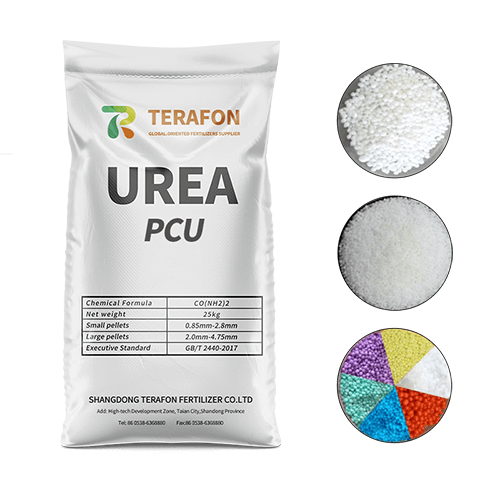
Polymer-Coated Urea (PCU)
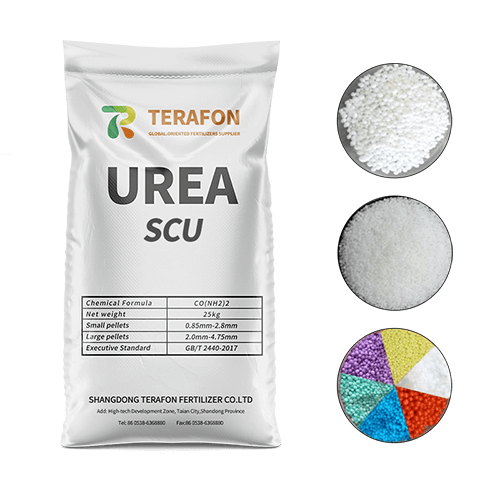
Sulfur-Coated Urea (SCU)
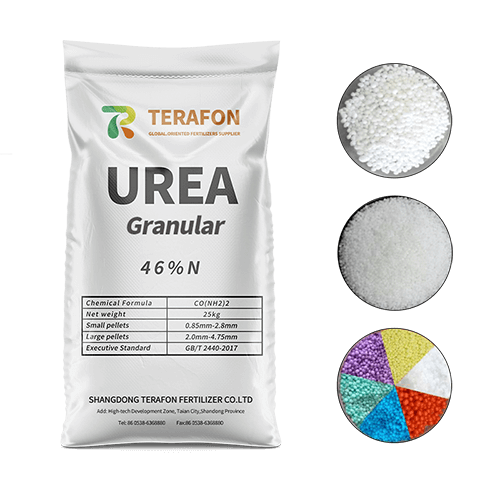
Urea-46%-Granular
Nitrogen Fertilizer
Suitable Crops

Fruit Crops

Cereal Crop

Leafy & Fruiting Vegetables

Oil Crops
Controlled-Release Urea: How It Differs from Conventional Urea
Learn how controlled-release urea differs from conventional urea in nitrogen release, nutrient efficiency, application methods, and crop nutrient management.
