


- Home » Choosing the Right NPK Fertilizer...
Choosing the Right NPK Fertilizer for Modern Farming
Efficient crop nutrition is a cornerstone of modern agriculture. Among the many fertilizer products used worldwide, NPK fertilizer remains the most widely applied nutrient solution because it provides the three primary macronutrients required for plant growth: nitrogen (N), phosphorus (P), and potassium (K).
Selecting the right fertilizer formula is not simply a matter of choosing the highest nutrient content. Effective fertilization strategies consider soil fertility, crop nutrient demand, environmental conditions, and crop growth stages. By understanding these factors, growers can choose the best NPK fertilizer for crops, improve nutrient use efficiency, and achieve higher yields while maintaining long-term soil health.
For growers and agricultural distributors seeking consistent fertilizer quality, manufacturers such as Terafon Fertilizer provide a wide range of professionally formulated NPK fertilizers designed for efficient crop nutrition and modern farming systems.
This guide explains how to choose the right NPK fertilizer and implement effective nutrient management strategies for sustainable agricultural production.
Table of Contents
- 1. Understanding NPK Fertilizer and Nutrient Functions
- 2. How NPK Fertilizer Ratios Work
- 3. Key Factors in Choosing the Right NPK Fertilizer
- 4. Recommended NPK Ratios for Different Crops
- 5. Crop Growth Stages and Fertilization Strategies
- 6. Types of NPK Fertilizers Used in Agriculture
- 7. Best Practices for Applying NPK Fertilizer
- 8. Common Fertilization Mistakes to Avoid
- Conclusion
1. Understanding NPK Fertilizer and Nutrient Functions
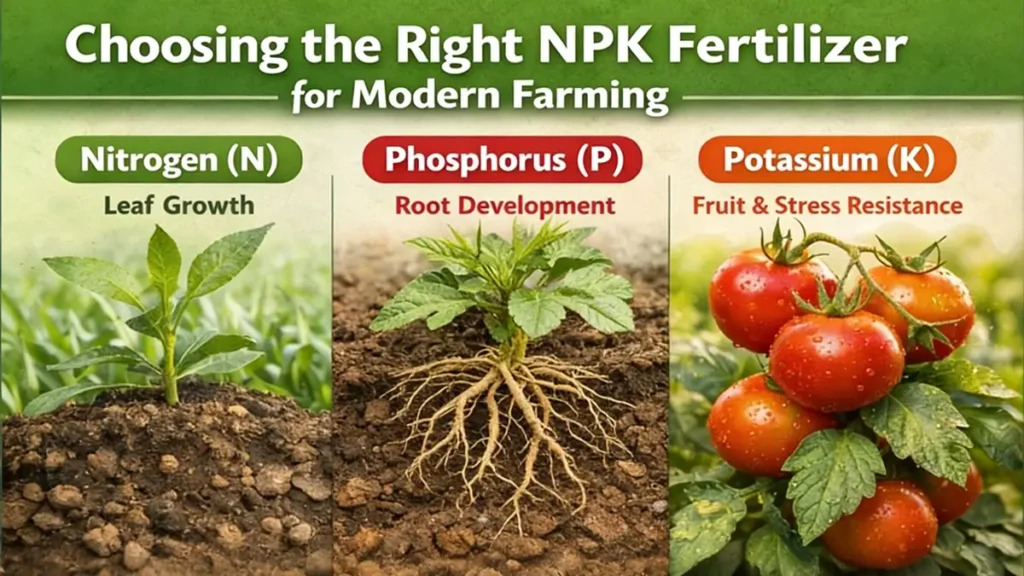
NPK fertilizer refers to a compound fertilizer that supplies the three essential nutrients required for plant growth. These nutrients play distinct roles in plant physiology and agricultural productivity.
Nitrogen (N)
Nitrogen is critical for vegetative growth, chlorophyll formation, and protein synthesis. Adequate nitrogen promotes vigorous leaf development and supports photosynthesis, making it essential for crops such as wheat, maize, and leafy vegetables.
Farmers often prioritize nitrogen-rich fertilizers when searching for the best NPK fertilizer for crop growth and yield improvement.Phosphorus (P)
Phosphorus plays an important role in root development, energy transfer (ATP), and early plant establishment. Crops supplied with sufficient phosphorus typically develop stronger root systems, enabling more efficient water and nutrient absorption.
Phosphorus fertilizers are particularly important during seedling and early vegetative growth stages.Potassium (K)
Potassium regulates many physiological functions, including enzyme activation, water regulation, and plant stress resistance. Adequate potassium improves plant tolerance to drought, pests, and diseases while also enhancing crop quality.
Fruit crops, potatoes, and vegetables often require higher potassium levels during reproductive growth stages.
Balanced NPK fertilization ensures plants receive the nutrients needed for optimal development throughout the growing season.
2. How NPK Fertilizer Ratios Work
NPK fertilizers are labeled using three numbers that represent the percentage of nitrogen, phosphorus, and potassium in the fertilizer.
For example:Understanding NPK fertilizer ratios explained on fertilizer labels helps farmers select the most suitable formulation for different crops and growth stages.
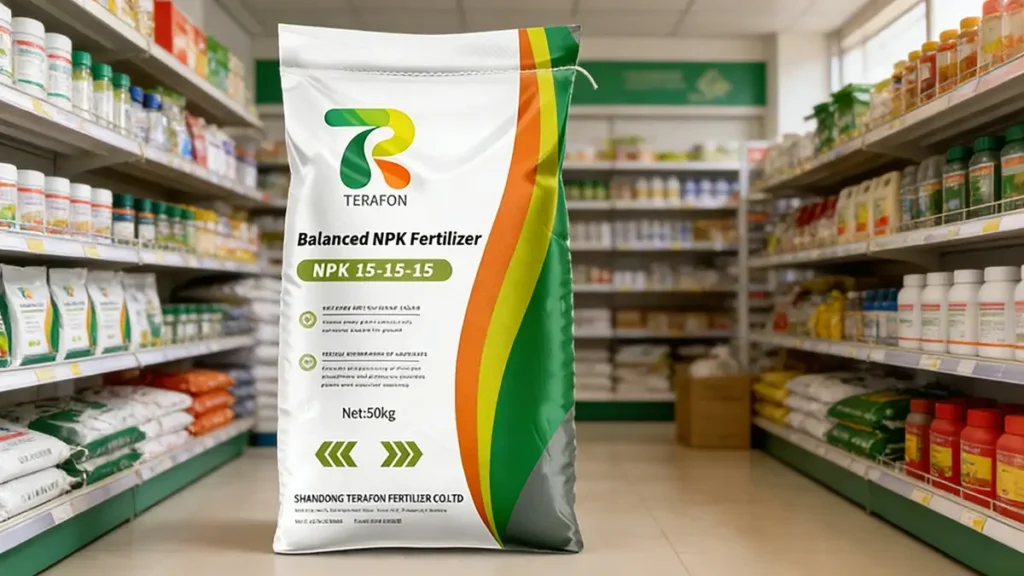
Balanced fertilizers such as 15-15-15 or 20-20-20 are commonly used for general agricultural production, while specialized ratios address specific nutrient deficiencies.
3. Key Factors in Choosing the Right NPK Fertilizer
Choosing the correct fertilizer requires careful evaluation of several agronomic factors.
Soil Nutrient Levels
Soil testing is one of the most reliable methods for determining nutrient availability and guiding fertilization decisions. Without proper soil analysis, growers may unintentionally apply excessive fertilizer or fail to correct nutrient deficiencies.
Soil analysis helps farmers determine how to choose the right NPK fertilizer for soil fertility management.Crop Type
Different crops require different nutrient ratios.
Examples include:- Leafy vegetables require higher nitrogen levels
- Root crops benefit from increased phosphorus
Fruit crops demand higher potassium supply
Crop Growth Stage
Crop nutrient requirements change throughout the growing cycle. Early growth requires strong root development, while later stages emphasize vegetative growth and fruit formation.
Understanding how to apply NPK fertilizer during different crop growth stages allows farmers to optimize nutrient supply and maximize yields.Climate and Soil Conditions
Environmental factors such as rainfall patterns, soil texture, and irrigation practices also influence fertilizer efficiency. Sandy soils, for example, often require more frequent nutrient applications due to higher nutrient leaching.
Mid-season nutrient management programs commonly incorporate high-efficiency fertilizer products. Many agricultural suppliers, including Terafon Fertilizer, offer balanced and crop-specific NPK formulations designed to support modern precision agriculture.
4. Recommended NPK Ratios for Different Crops
Different crop categories typically require specific nutrient ratios for optimal growth.
| Crop Category | Typical NPK Ratio |
|---|---|
| Leafy vegetables | 20-10-10 |
| Root crops | 5-10-10 |
| Fruit crops | 10-30-20 |
| Cereals (wheat, maize) | 20-20-0 |
| Vegetable crops | 19-19-19 or 20-20-20 |
These formulations help growers select the best NPK fertilizer for vegetables and field crops while maintaining balanced plant nutrition.
5. Crop Growth Stages and Fertilization Strategies
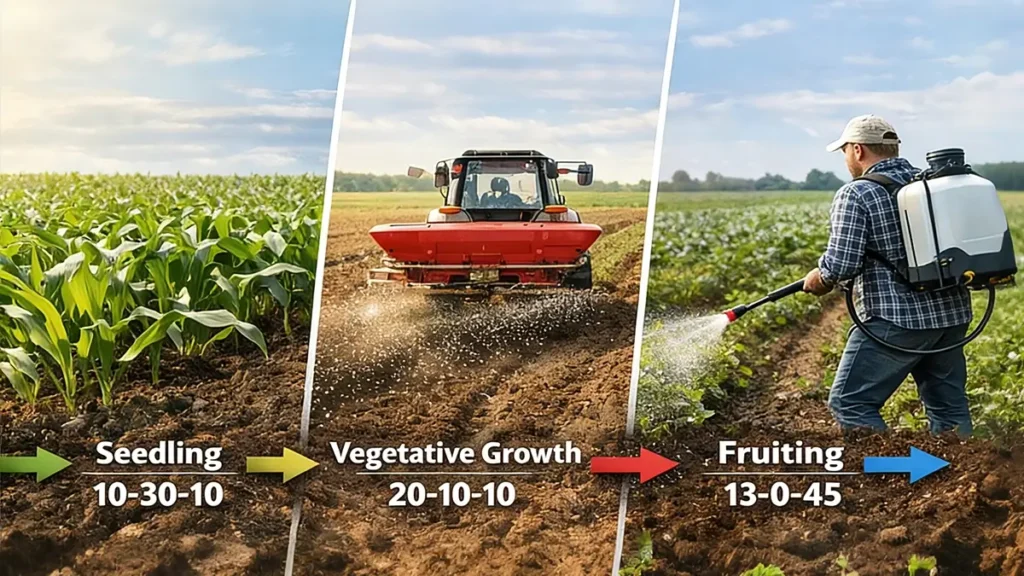
Modern nutrient management programs often use stage-specific fertilization to optimize plant growth.
Early Growth Stage
During early development, plants require strong root systems. Fertilizers with higher phosphorus content support root formation and early plant establishment.
Examples include:
- 10-30-10
- 12-32-16
Vegetative Growth Stage
During vegetative growth, nitrogen becomes the dominant nutrient for leaf and stem development.
Typical fertilizer ratios include:
Typical fertilizer ratios include:
- 20-10-10
- 30-10-10
Flowering and Fruiting Stage
Potassium becomes increasingly important during reproductive growth stages.
Common fertilizer ratios include:
- 12-12-36
- 13-0-45
Potassium-rich fertilizers improve fruit size, color, and shelf life.
6. Types of NPK Fertilizers Used in Agriculture
Several types of NPK fertilizers are commonly used in modern agriculture.
Granular NPK Fertilizer
Granular fertilizers are widely used in field agriculture due to their ease of storage, long shelf life, and compatibility with mechanized spreading equipment.
They are typically applied as basal fertilizers or broadcast across large agricultural fields.Liquid NPK Fertilizer
Liquid fertilizers provide faster nutrient absorption and are often used in fertigation and foliar feeding systems.
Growers frequently choose liquid fertilizers when exploring how to apply NPK fertilizer through irrigation systems.
Growers frequently choose liquid fertilizers when exploring how to apply NPK fertilizer through irrigation systems.
Slow-Release NPK Fertilizer
Slow-release fertilizers gradually release nutrients over time, improving nutrient efficiency and reducing nutrient losses caused by leaching.
These fertilizers are particularly useful in sustainable agriculture and precision nutrient management programs.
7. Best Practices for Applying NPK Fertilizer
To maximize nutrient efficiency and crop yield, farmers should follow several best practices:
- Conduct soil testing before fertilizer application
- Apply nitrogen fertilizers in split applications
- Adjust fertilizer ratios based on crop growth stages
- Combine macronutrients with essential micronutrients when necessary
Apply fertilizers under suitable soil moisture conditions
8. Common Fertilization Mistakes to Avoid
Even experienced growers can encounter fertilization challenges. Common mistakes include:
- Applying the same fertilizer formula to all crops
- Ignoring soil nutrient testing
- Over-applying nitrogen fertilizers
- Applying fertilizer during extreme drought conditions
Failing to adjust fertilization during crop growth stages
Avoiding these mistakes helps maintain balanced soil fertility and reduces unnecessary fertilizer costs.
Conclusion
Choosing the right NPK fertilizer is essential for improving crop productivity, maximizing nutrient efficiency, and maintaining sustainable soil fertility.
By understanding nutrient functions, evaluating soil conditions, and selecting appropriate fertilizer ratios based on crop requirements and growth stages, farmers can develop more effective nutrient management programs.
Modern agriculture increasingly relies on precision fertilization and balanced nutrient management to achieve higher yields and sustainable production. Fertilizer suppliers such as Terafon Fertilizer continue to support this transition by providing high-quality NPK fertilizers designed for efficient crop nutrition and reliable agricultural performance.
With proper planning and application, NPK fertilizers remain one of the most effective tools for improving global agricultural productivity while supporting sustainable farming practices.
Frequently Asked Questions (FAQ)
They show the percentage of Nitrogen (N), Phosphorus (P), and Potassium (K). For example, 20‑10‑10 has 20% N, 10% P, and 10% K.
Check soil nutrients, crop type, and growth stage. Soil tests help pick the best NPK ratio.
It boosts crop growth, improves yield, strengthens roots, and increases plant stress resistance.
Before planting (base)
During vegetative growth (nitrogen)
During flowering/fruiting (potassium)
Yes. Overuse can damage roots, upset soil balance, and pollute the environment. Apply recommended amounts.
Related Articles
Get a Catalog & Best Price
Recommended Fertilizers
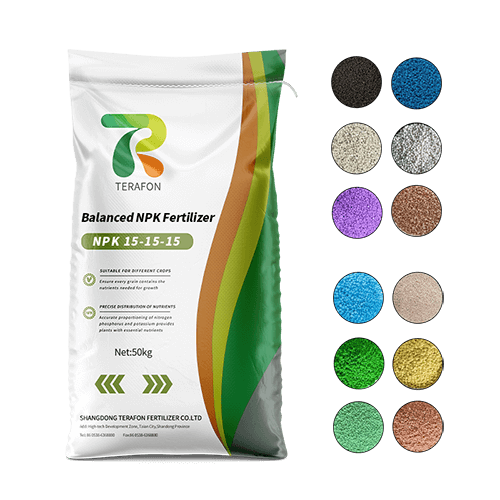
Balanced NPK Fertilizer
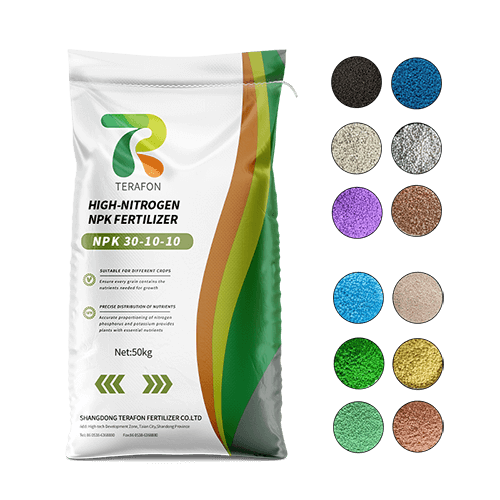
High-Nitrogen NPK Fertilizer
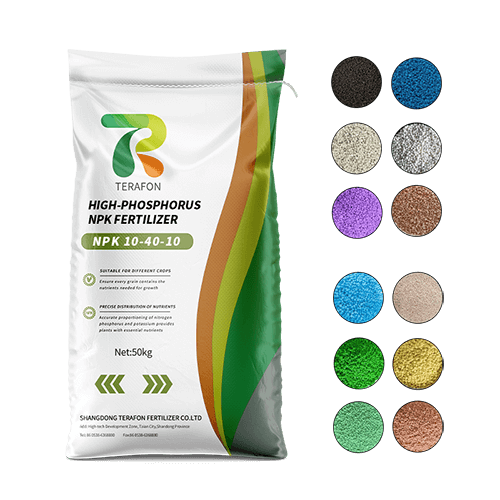
High‑Phosphorus NPK Fertilizer
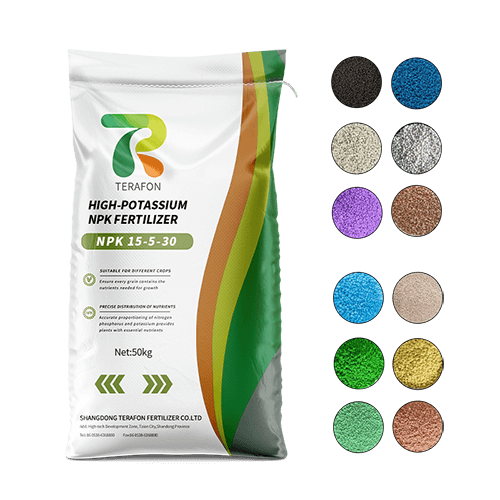
High-Potassium NPK Fertilizer
Suitable Crops
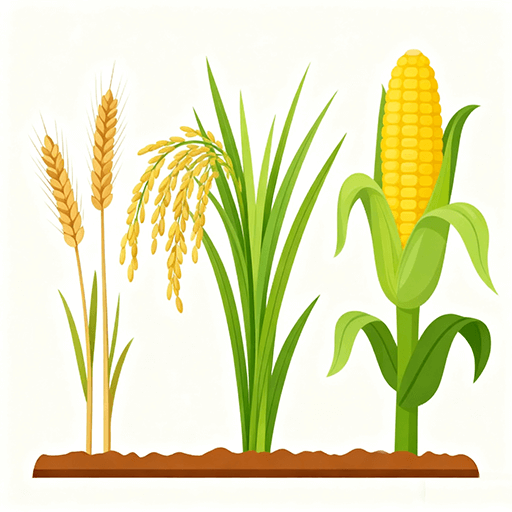
Cereal Crop
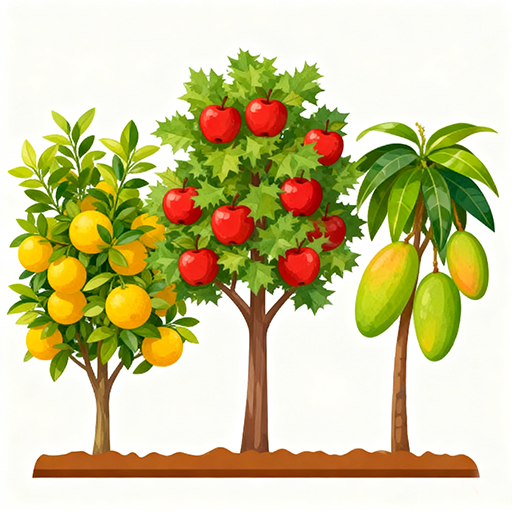
Fruit Trees

Berry & Vine Crops
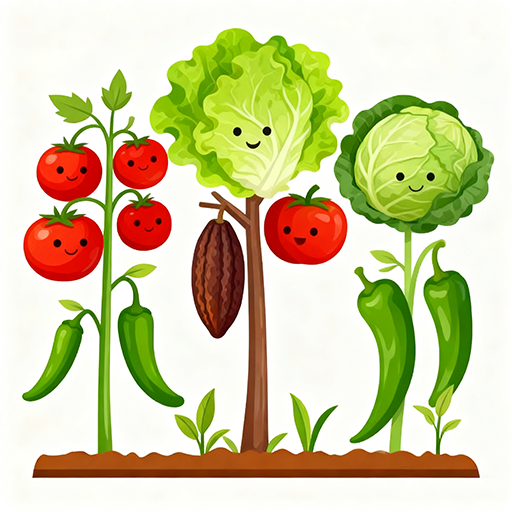
Leafy & Fruiting Vegetables
NPK Fertilizer: Supporting Balanced Crop Nutrition
Apply NPK fertilizer through soil application, fertigation, or foliar spray to supply essential nitrogen, phosphorus, and potassium, promoting healthy plant growth and improved crop yield. Terafon Fertilizer offers high-quality NPK formulations for efficient and sustainable crop nutrition.
