


What Is PCU Urea? Benefits of Polymer Coated Urea Explained
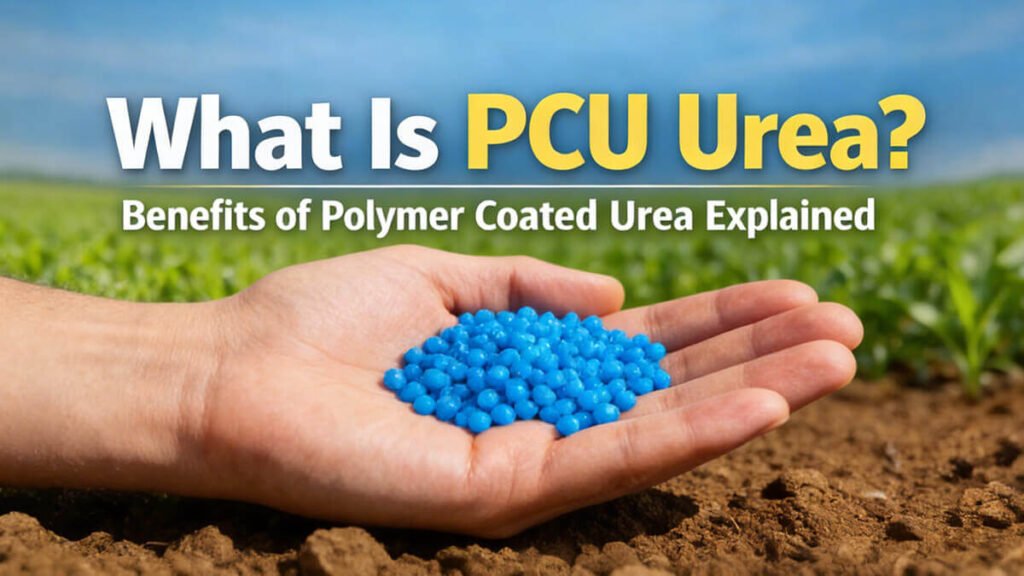
Nitrogen fertilizers are essential for modern crop production, but conventional urea often suffers from low efficiency and environmental losses. Polymer Coated Urea (PCU), a controlled release nitrogen fertilizer, improves nitrogen use efficiency, supports higher crop yields, and reduces leaching and greenhouse gas emissions. Fertilizer providers, including Terafon Fertilizer, evaluate PCU to enable sustainable nutrient management across diverse cropping systems.
Table of Contents
1. What is PCU Urea?
1.1 Definition and Composition
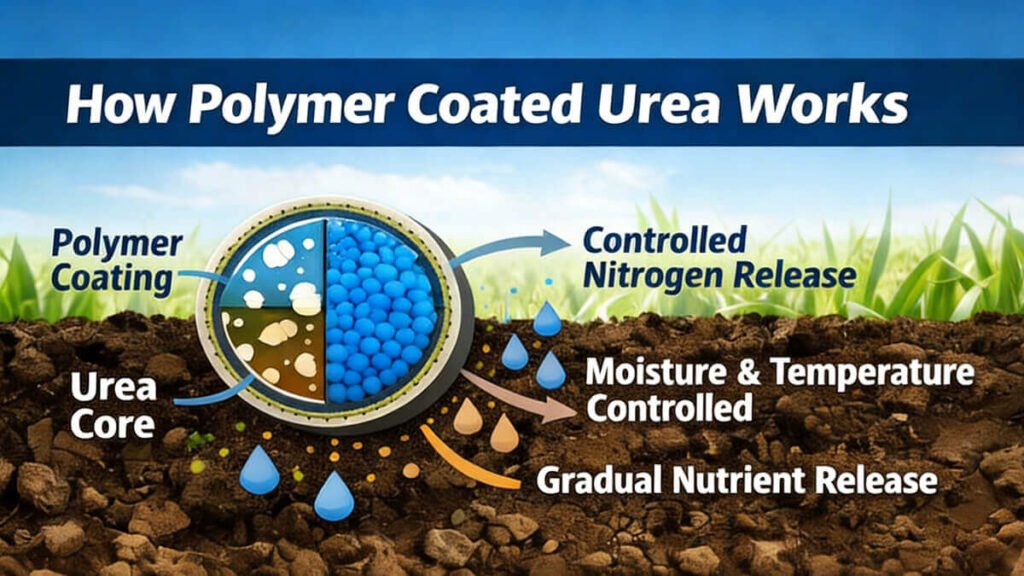
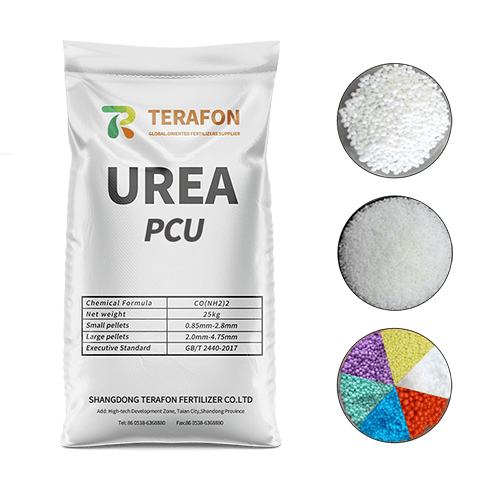
PCU urea is a nitrogen fertilizer in which standard urea granules are coated with a polymer membrane designed to regulate nitrogen release over time. The polymer layer acts as a semi-permeable barrier, allowing nitrogen diffusion at a controlled rate influenced by soil temperature and moisture conditions.
This structure distinguishes PCU from both conventional urea and other enhanced-efficiency fertilizers, positioning it as a long-lasting nitrogen source for crops requiring sustained nutrient availability.
1.2 Differences Between PCU and Conventional Urea
Conventional urea dissolves rapidly after application, releasing nitrogen in a short period that often exceeds plant uptake capacity. In contrast, PCU provides a gradual nitrogen supply, reducing peak concentrations in soil and improving nutrient synchronization throughout the crop growth cycle.
2. How Polymer Coated Urea Works
After application, soil moisture penetrates the polymer coating and dissolves the urea core. Nitrogen is then released gradually through diffusion, rather than immediate dissolution. This mechanism supports a controlled release nitrogen fertilizer strategy, particularly effective in crops with extended growth periods such as maize, rice, and wheat.
By maintaining a stable nitrogen supply, PCU helps reduce nutrient stress during key developmental stages, including tillering, flowering, and grain filling.
3. Agronomic Benefits of PCU
3.1 Improved Nitrogen Use Efficiency (NUE)
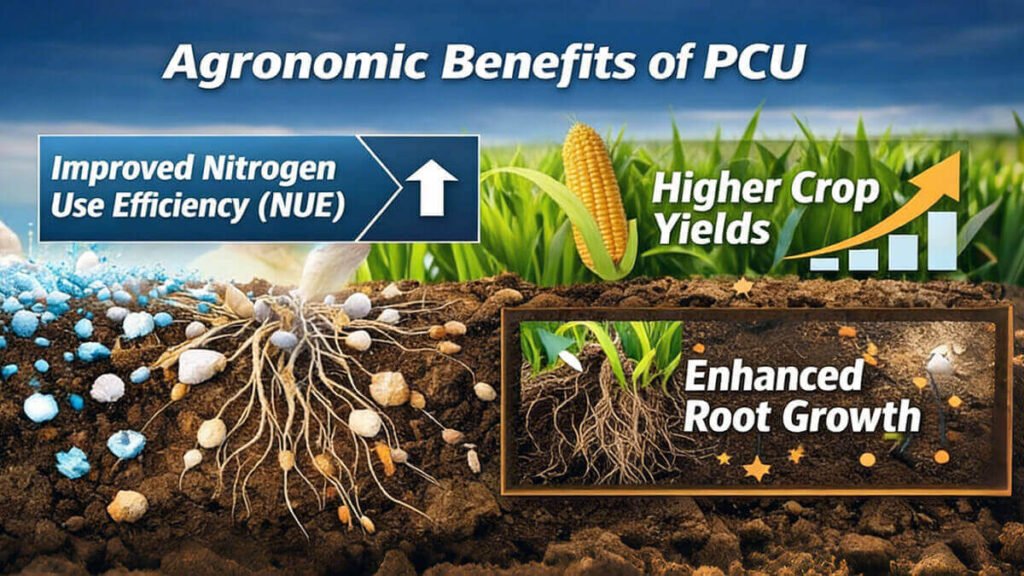
One of the most widely reported advantages of PCU is improved nitrogen use efficiency. Controlled release patterns allow crops to absorb a greater proportion of applied nitrogen, often resulting in 25–50% higher NUE compared to conventional urea under similar conditions.
3.2 Higher and More Stable Crop Yields
PCU supports yield stability by ensuring nitrogen availability during critical growth phases. Numerous field evaluations indicate that controlled release nitrogen fertilizer for maize and rice can maintain or increase yields while reducing total nitrogen input rates.
3.3 Root Development and Physiological Improvements
Sustained nitrogen availability promotes deeper root systems, enhanced photosynthetic activity, and improved nutrient transport within plants. These physiological improvements contribute to stronger crop resilience and more efficient nutrient uptake.
3.4 Reduced Nitrogen Loss Pathways
PCU significantly lowers nitrogen losses through:
- Ammonia volatilization
- Nitrate leaching
Nitrous oxide emissions
These reductions are critical for reducing nitrogen leaching and greenhouse gas emissions in intensive agricultural systems.
4. Key Technical Parameters of Polymer Coated Urea
Understanding technical specifications helps ensure correct product selection and application.
| Item | Typical Specification |
|---|---|
| Product Type | Polymer Coated Urea (PCU) |
| Total Nitrogen (N) | 46% |
| Granule Size | 2.0 – 4.0 mm |
| Coating Material | High-performance polymer |
| Coating Ratio | 2% – 8% |
| Controlled Release Period | 30 / 60 / 90 / 120 / 180 days |
| Initial Release (25°C) | 5% – 15% |
| Release Mechanism | Water penetration and diffusion |
| Application Method | Basal application, broadcasting, banding |
| Storage Conditions | Cool, dry, well-ventilated area |

5. Environmental Benefits of PCU Urea
From an environmental perspective, PCU supports climate-smart agriculture by:
- Minimizing nitrate contamination of groundwater
- Reducing nitrogen-related greenhouse gas emissions
Supporting long-term soil health through balanced nutrient availability
Mid-chain fertilizer suppliers and agronomic solution providers such as Terafon Fertilizer often assess PCU technology within broader sustainability frameworks aimed at improving both productivity and environmental performance.
6. Economic Implications for Modern Farming
Although PCU typically carries a higher unit cost than conventional urea, its economic value is reflected in:
- Reduced application frequency
- Lower nitrogen loss-related waste
More consistent yields across variable soil conditions
In many cropping systems, these factors translate into improved overall profitability and better return on fertilizer investment.
7. Limitations and Technical Considerations
espite its advantages, PCU adoption requires consideration of:
- Higher initial fertilizer cost
- Potential release mismatch under extreme climatic conditions
Ongoing research into polymer coating biodegradability
Proper product selection and agronomic planning are essential to fully realize PCU’s benefits.
8. Conclusion
Polymer Coated Urea (PCU) represents a major advancement in nitrogen fertilizer technology. By improving nitrogen use efficiency, stabilizing crop yields, and reducing environmental losses, PCU aligns with the evolving goals of sustainable and precision agriculture.
As fertilizer innovation continues, manufacturers and solution-oriented companies such as Terafon Fertilizer contribute to the evaluation and application of controlled-release technologies that support long-term agricultural productivity and environmental responsibility.
SCU UREA Frequently Asked Questions (FAQs)
PCU slows nitrogen release to better match the crop’s nutrient uptake pattern. This synchronization reduces nitrogen losses from volatilization, leaching, and denitrification, allowing more of the applied nitrogen to be absorbed by plants, resulting in higher Nitrogen Use Efficiency (NUE) and often better yields.
The release rate is primarily driven by soil temperature and moisture. Higher temperatures and moisture accelerate diffusion through the polymer coating, while cooler, drier conditions slow it down. This responsive release mechanism is why PCU is considered a smart fertilizer technology.
Yes. By matching nitrogen release with plant demand, PCU helps lower nitrogen losses to the environment — including reduced nitrate leaching into water and decreased emissions of nitrous oxide, a potent greenhouse gas — compared to conventional urea.
PCU is widely applicable but is most effective when used in systems where extended nitrogen availability aligns with crop growth stages (e.g., cereals like maize, rice, wheat). Crop type, soil conditions, and climate should always be considered when selecting the appropriate PCU product and formulation.
Some research indicates that polymer coatings used in PCU can biodegrade over time after nutrient release, reducing concerns about long‑term residues in soil. However, the extent and rate of degradation depend on coating materials and environmental conditions.
Recommended Fertilizers
Industrial-Urea
Agricultural urea
Polymer-Coated Urea (PCU)

Automotive-Grade-UreaI-(SCR)
Suitable Crops

Fruit Trees & Orchards

Berry & Vine Crops

Leafy & Fruiting Vegetables

Root & Bulb Vegetables
Choose High-Quality Food Grade Urea with Confidence
Select food grade urea based on purity level, CAS number, compliance standards, and application requirements to ensure safe use, stable performance, and consistent quality. Contact Terafon Fertilizer for professional guidance and reliable food grade urea solutions.
