


- Home » Types of Nitrogen Fertilizers: Complete Guide...
Types of Nitrogen Fertilizers: Complete Guide for Crops & Soil
Nitrogen fertilizers are essential for crop growth, yield formation, and efficient nutrient management in modern agriculture. This guide explains the main types of nitrogen fertilizers—including urea, ammonium nitrate, ammonium chloride, ammonium sulfate, liquid nitrogen solutions, controlled-release fertilizers, and organic nitrogen sources—highlighting their characteristics, soil behavior, and practical applications.
It provides clear guidance on selecting the right nitrogen fertilizer based on crop requirements, soil conditions, and climate, while outlining best practices to improve nitrogen use efficiency and reduce environmental losses. Developed with agronomic expertise, Terafon Fertilizer supports farmers and agribusinesses with reliable nitrogen fertilizer solutions designed to enhance productivity and promote sustainable agriculture.
Table of Contents
- 1. Introduction: Why Nitrogen Is Essential for Crop Growth
- 2. How Nitrogen Fertilizers Function in Soil Systems
- 3. Classification of Nitrogen Fertilizers
- 4. Major Types of Nitrogen Fertilizers Explained
- 5. How to Choose the Best Nitrogen Fertilizer for Your Crops
- 6. Nitrogen Fertilizer Application Best Practices
- 7. Environmental Impact and Sustainable Nitrogen Use
- 8. Future Trends in Nitrogen Fertilizer Technology
- 9. Conclusion
1. Introduction: Why Nitrogen Is Essential for Crop Growth
Nitrogen (N) is the most critical macronutrient determining crop yield and biomass production. It is a fundamental component of chlorophyll, amino acids, proteins, enzymes, and nucleic acids, directly influencing photosynthesis, vegetative growth, and grain development.
Nitrogen deficiency in crops typically results in slow growth, reduced leaf area, chlorosis (yellowing of leaves), poor tillering, and ultimately significant yield losses. Because native soil nitrogen mineralization rarely meets the nutrient demand of high-yield cropping systems, nitrogen fertilizers play a central role in modern agricultural production worldwide.
Since the industrial adoption of the Haber–Bosch process, nitrogen fertilization has become a cornerstone of global food security. Today, optimizing nitrogen fertilizer selection and application is not only an agronomic priority but also an environmental and economic necessity.2. How Nitrogen Fertilizers Function in Soil Systems
- Urea hydrolysis, converting urea into ammonium nitrogen
- Nitrification, transforming ammonium into nitrate nitrogen
- Denitrification, producing nitrogen gases under anaerobic conditions
- Ammonia volatilization, particularly from surface-applied urea
Nitrate leaching, common in coarse-textured soils and high-rainfall areas
3. Classification of Nitrogen Fertilizers
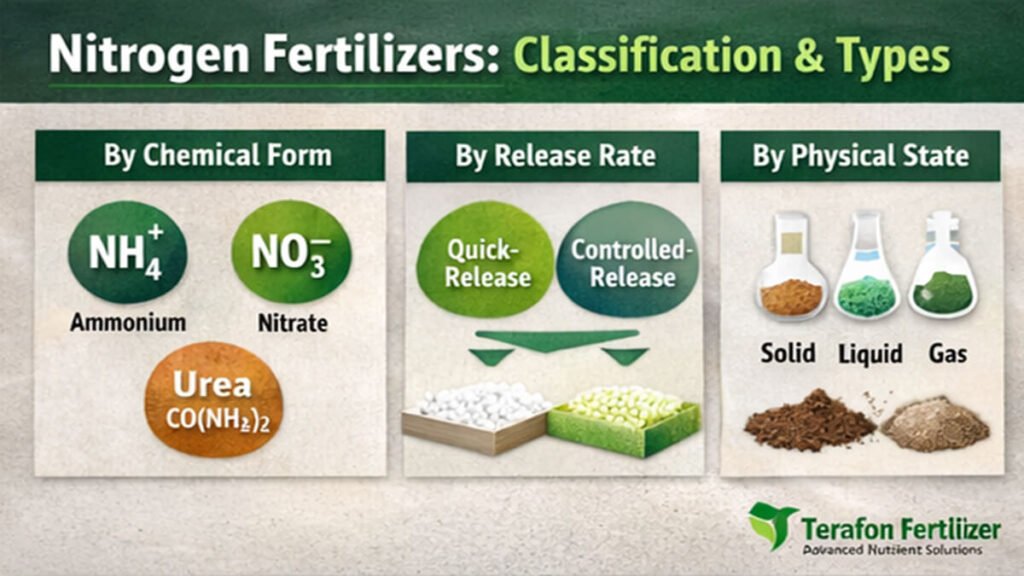
3.1 Classification by Chemical Nitrogen Form
- Ammonium nitrogen (NH₄⁺)
Positively charged, retained by soil colloids, and less prone to leaching. - Nitrate nitrogen (NO₃⁻)
Immediately available for plant uptake but highly mobile and leaching-prone. Amide nitrogen (urea-based fertilizers)
Requires enzymatic conversion before becoming plant-available, yet offers the highest nitrogen concentration.
Balanced fertilizer programs often integrate multiple nitrogen forms to support early-season growth and sustained nutrient supply.
3.2 Classification by Nitrogen Release Pattern
- Conventional quick-release nitrogen fertilizers provide rapid nitrogen availability but require precise timing.
Controlled-release and slow-release nitrogen fertilizers are engineered to release nitrogen gradually, aligning nutrient availability with crop uptake and reducing losses.
3.3 Classification by Physical Form
- Solid nitrogen fertilizers: granules or prills for broadcasting or band placement
- Liquid nitrogen fertilizers: commonly used for fertigation and precision spraying
- Gaseous nitrogen fertilizers: injected directly into soil, such as anhydrous ammonia
4. Major Types of Nitrogen Fertilizers Explained
4.1 Urea Fertilizer (46% Nitrogen)
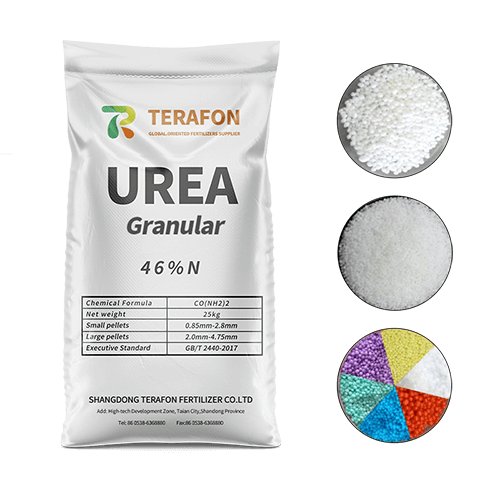
Urea is the most widely used nitrogen fertilizer globally due to its high nitrogen concentration, ease of handling, and cost efficiency. Containing approximately 46% nitrogen, urea fertilizer is extensively used in cereals, maize, rice, and oilseed production systems.
After application, urea must be hydrolyzed to ammonium nitrogen before plant uptake. Proper soil incorporation, irrigation, or the use of urease inhibitors significantly reduces ammonia volatilization and improves nitrogen recovery.
4.2 Ammonium Nitrate Fertilizer (33–34% Nitrogen)
Ammonium nitrate fertilizer supplies nitrogen in both ammonium and nitrate forms, offering immediate availability and sustained uptake. This dual-form nitrogen source is particularly effective in cool and temperate climates where rapid crop response is required.
Due to safety and regulatory concerns, ammonium nitrate use is restricted in some regions, leading to increased adoption of alternative nitrogen formulations.
4.3 Ammonium Sulfate Fertilizer (21% Nitrogen + Sulfur)
Ammonium sulfate fertilizer provides both nitrogen and sulfur—an essential nutrient for protein synthesis and enzyme activation. Its acidifying effect makes it especially suitable for alkaline or sulfur-deficient soils.
It is commonly used in oilseed crops, legumes, forage systems, and intensive cropping programs requiring balanced N and S nutrition.
4.4 Anhydrous Ammonia Fertilizer (≈82% Nitrogen)
Anhydrous ammonia is the most concentrated nitrogen fertilizer available, containing approximately 82% nitrogen. It is injected directly into soil and widely used in large-scale grain production due to its high nitrogen efficiency and low cost per unit of nutrient.
Strict safety procedures and specialized equipment are required for its application.
4.5 Calcium Nitrate Fertilizer (≈15.5% Nitrogen + Calcium)
Calcium nitrate fertilizer supplies readily available nitrate nitrogen along with calcium, which plays a vital role in cell wall strength, fruit quality, and stress resistance.
This fertilizer is widely used in horticultural crops, greenhouse systems, and fertigation programs where precise nutrient control is essential.
4.6 Liquid Nitrogen Fertilizers (UAN Solutions)
UAN liquid nitrogen fertilizers (such as UAN 28 or UAN 32) combine urea and ammonium nitrate in liquid form. These fertilizers support uniform application, flexible timing, and split nitrogen dosing, making them well suited to modern precision agriculture systems.
At this stage of nitrogen management, Terafon Fertilizer supports growers with both solid and liquid nitrogen solutions designed for compatibility with fertigation systems and precision application equipment.
4.7 Controlled-Release and Coated Nitrogen Fertilizers
Controlled-release nitrogen fertilizers, including polymer-coated and sulfur-coated urea, are classified as enhanced efficiency fertilizers. They are designed to synchronize nitrogen release with crop uptake, reducing volatilization, leaching, and greenhouse gas emissions.
These products are increasingly used in high-value crops and environmentally sensitive regions where nutrient losses must be minimized.
4.8 Organic Nitrogen Fertilizers
Organic nitrogen sources are widely adopted in organic farming systems and regenerative agriculture practices.
5. How to Choose the Best Nitrogen Fertilizer for Your Crops
Selecting the appropriate nitrogen fertilizer depends on:
- Crop species and growth stage
- Soil texture, pH, and organic matter content
- Climate conditions and rainfall distribution
Application method and farm equipment
6. Nitrogen Fertilizer Application Best Practices
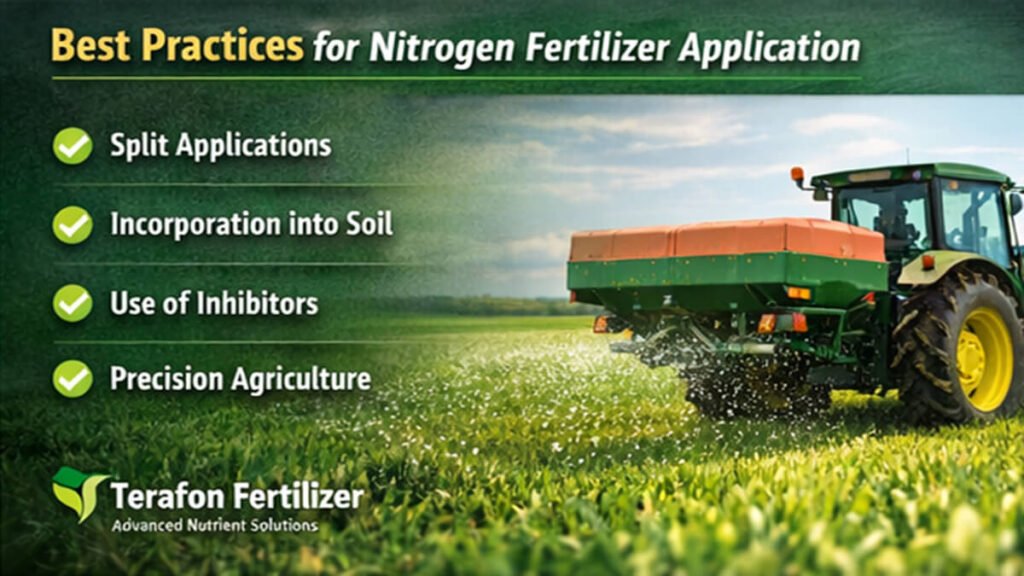
- Apply nitrogen fertilizer in split applications aligned with crop uptake
- Incorporate surface-applied urea fertilizers where possible
- Use urease and nitrification inhibitors to reduce nitrogen losses
- Adopt precision agriculture tools for site-specific nutrient management
7. Environmental Impact and Sustainable Nitrogen Use
8. Future Trends in Nitrogen Fertilizer Technology
- Enhanced efficiency fertilizers
- Low-carbon nitrogen production pathways
- Digital nutrient decision-support systems
- Integration of biological nitrogen fixation technologies
9. Conclusion
Nitrogen fertilizers remain indispensable for modern agriculture. From conventional urea and ammonium-based fertilizers to advanced controlled-release and organic nitrogen sources, each product category serves specific agronomic needs.
By understanding nitrogen fertilizer types, soil behavior, and best management practices, farmers and agronomists can improve productivity while reducing environmental impact. As a long-term partner in plant nutrition, Terafon Fertilizer continues to support sustainable agriculture through reliable nitrogen fertilizer solutions and agronomic expertise.
Get a Catalog & Best Price
Recommended Fertilizers
Urea Fertilizer
View Solutions
NPK Fertilizer
View Solutions
Water Soluble Fertilizer
View Solutions
Fulvic-Acid-Fertilizer
View SolutionsSuitable Crops
Cereal Crops
Legume Crops
Root & Tuber Crops
Fruit Crops
Nitrogen Fertilizer Guide: Urea, Ammonium & Nitrate Types
Compare urea, ammonium, and nitrate nitrogen fertilizers to improve nutrient efficiency and crop yield. Contact Terafon Fertilizer for expert support and tailored nitrogen solutions.
