


- Home » Comprehensive Guide to Liquid Fertilizer Types...
Comprehensive Guide to Liquid Fertilizer Types for Crops
Liquid fertilizers provide crops with nutrients in fully soluble or suspended forms, enabling rapid absorption, precise application, and high efficiency. This guide explores their classification by physical form, nutrient function, application method, and source, detailing clear solutions, suspension fertilizers, NPK blends, chelated micronutrients, and organic options. Learn best practices for selection and application to improve yield, crop quality, and sustainability. Terafon Fertilizer delivers professional solutions tailored for modern agriculture.
Table of Contents
1. Introduction to Liquid Fertilizers
Liquid fertilizers are nutrient solutions in which essential plant nutrients are fully dissolved or suspended in water, enabling precise, rapid, and efficient delivery to crops. Unlike solid fertilizers, liquid fertilizers are immediately available for plant uptake, making them ideal for modern precision agriculture, horticulture, and high-value crop production.
Terafon Fertilizer provides a wide range of liquid fertilizer solutions that ensure uniform nutrient availability, faster absorption, and optimized growth performance across various crops.
Liquid fertilizers typically contain macronutrients (N, P, K) , Secondary Nutrient(Ca–Mg–S) and micronutrients (Fe, Zn, Mn, B, etc.), and they can be applied through foliar spraying, fertigation systems, or soil drenching depending on crop needs.
2. Key Classification Criteria of Liquid Fertilizers
2.1 Based on Physical Form
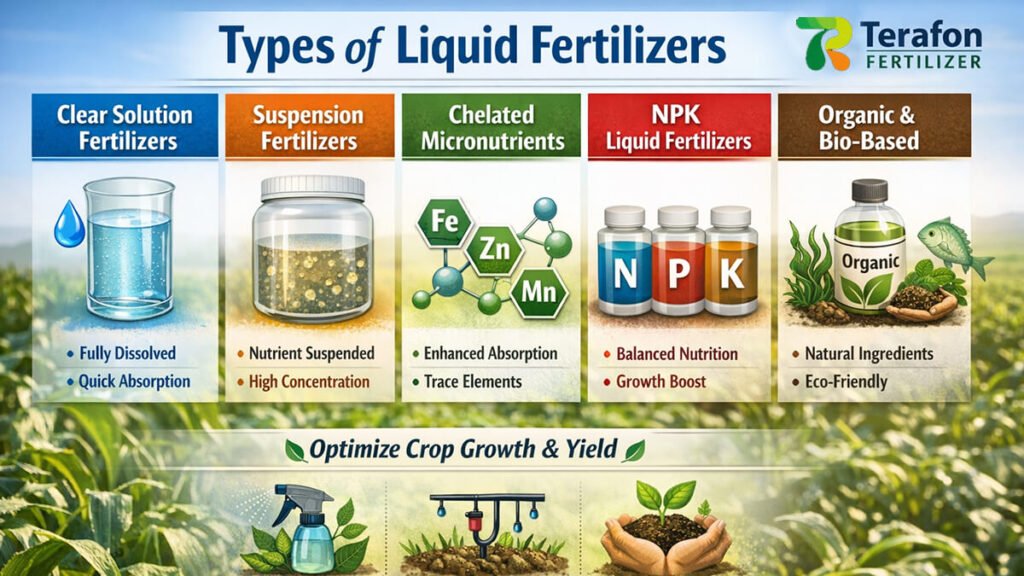
- Clear Solution Fertilizers – Nutrients are fully dissolved in water, creating a stable, uniform solution suitable for irrigation and spraying.
- Suspension Fertilizers – Contain fine, insoluble particles that remain suspended with the help of stabilizers, offering higher nutrient concentrations but requiring careful handling.
2.2 Based on Nutrient Function
- Nitrogen-Based Fertilizers – Promote vegetative growth, leaf expansion, and photosynthesis efficiency.
- Phosphorus-Based Fertilizers – Support root development, flowering, and fruit set.
- Potassium-Based Fertilizers – Enhance stress resistance, fruit quality, and overall plant health.
- Balanced NPK Fertilizers – Provide a complete nutrient profile for all growth stages.
Micronutrient Fertilizers – Address deficiencies of Zn, Fe, Mn, B, and other trace elements.
2.3 Based on Application Method
- Soil/Root Application – Delivered through irrigation systems directly to the root zone for continuous nutrient uptake.
Foliar Application – Sprayed directly onto leaves for rapid absorption, often used to quickly correct nutrient deficiencies.
2.4 Based on Source and Composition
- Inorganic Fertilizers – Chemically synthesized nutrients with high concentration and immediate availability.
Organic and Bio-Based Fertilizers – Derived from natural sources such as seaweed extracts, fermented biomass, or compost teas; improve soil health and support sustainable agriculture.
3. Detailed Overview of Common Liquid Fertilizers
3.1 Clear Solution Fertilizers
Clear solution fertilizers, such as UAN (Urea Ammonium Nitrate), are fully soluble and provide uniform nutrient distribution.
Advantages:- Compatible with fertigation and spray systems
- No risk of nozzle or pipeline clogging
Rapid nutrient uptake for immediate crop response
3.2 Suspension Fertilizers
Suspension fertilizers contain finely ground nutrient particles that remain evenly dispersed in water with stabilizers. They allow higher nutrient concentrations than clear solutions but require careful handling to prevent settling.
Applications:- High-demand crops
Precision fertigation systems in greenhouses and open-field high-value crops
3.3 Chelated Micronutrient Fertilizers
Micronutrients such as Fe, Zn, and Mn are often chelated to increase stability and plant absorption. These fertilizers are particularly effective for correcting trace element deficiencies quickly.
Use Cases:- Foliar spraying on fruit trees, vegetables, and other high-value crops
Rapid correction of deficiency symptoms
3.4 Macro-Nutrient (NPK) Functional Fertilizers
- Nitrogen-rich formulas for leafy crops
- Phosphorus-focused formulas for root and flower development
- Potassium-focused formulas for fruit quality and stress resistance
Balanced NPK formulas covering the full growth cycle
Terafon Fertilizer offers professional NPK liquid fertilizers optimized for different crops, ensuring complete nutrition and efficient growth management.
These products are derived from organic materials, fermented biomass, or seaweed extracts, often enriched with amino acids and natural micronutrients.
Benefits:- Enhance soil microbial activity and fertility
Suitable for organic and sustainable farming systems
4. Advantages and Application Scenarios
- Rapid nutrient availability – nutrients are immediately accessible to plants
- Precision application – easily integrated with irrigation systems for fertigation
- Improved fertilizer use efficiency – reduces nutrient loss and uneven application
Flexible integration – can be combined with foliar sprays or other agronomic inputs
- High-value crops in greenhouse or protected agriculture
- Vegetable and fruit production
Precision horticulture and ornamental plant management
5. Selection and Best Application Practices
- Match fertilizer type with crop needs – N-rich for leafy vegetables, K-rich for fruit crops.
- Check compatibility – always conduct small-scale trials before mixing with other chemicals.
- Stage-specific application – adjust nutrient ratios based on crop growth stages to maximize yield and quality.
Follow label guidelines – correct dilution rates, timing, and method of application improve effectiveness and safety.
6. Conclusion: The Value of Liquid Fertilizers in Modern Agriculture
Liquid fertilizers are essential for modern agriculture due to their rapid absorption, precise control, and compatibility with mechanized systems. Understanding their classification and proper application helps growers increase yields, improve crop quality, and achieve sustainable agricultural outcomes.
With Terafon Fertilizer solutions, growers gain access to professional, high-quality Liquid fertilizers designed to optimize crop nutrition, support sustainable growth, and meet the demands of modern precision agriculture.
Recommended Fertilizers
Urea Fertilizer
View Solutions
NPK Fertilizer
View Solutions
Water Soluble Fertilizer
View Solutions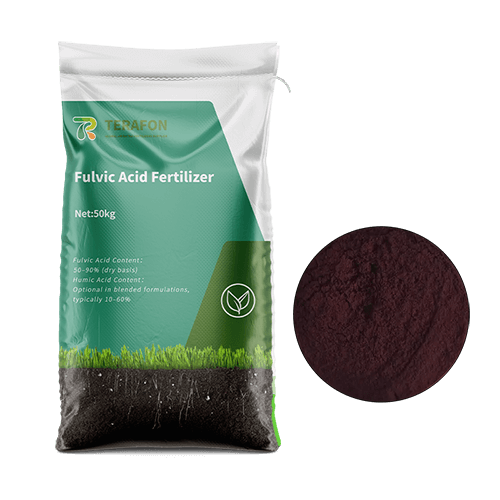
Fulvic-Acid-Fertilizer
View SolutionsSuitable Crops
Cereal Crops

Legume Crops
Root & Tuber Crops

Fruit Crops
Types of Liquid Fertilizers for Optimal Crop Nutrition
Explore the different types of liquid fertilizers to meet the specific nutrient needs of your crops. Contact our agronomy team for expert guidance and customized liquid fertilizer recommendations.
