


- Home » Liquid vs Granular Nitrogen Fertilizer....
Liquid vs Granular Nitrogen Fertilizer: Which Is Best?

As modern agriculture shifts toward precision nutrient management and sustainability, SCU Urea (Sulfur-Coated Urea) has become an increasingly important controlled-release nitrogen fertilizer for major staple crops such as rice, wheat, and maize. When applied correctly, SCU Urea helps synchronize nitrogen release with crop demand, significantly improving nitrogen use efficiency (NUE) while reducing environmental nitrogen losses.
Many fertilizer manufacturers, including Terafon Fertilizer, have developed SCU-based nitrogen solutions to support efficient and sustainable crop nutrition across diverse cropping systems.
Table of Contents
- 1. What Is SCU Urea and Why It Matters
- 2. Nitrogen Release Characteristics and Technical Parameters of SCU
- 3. Best SCU Urea Application Strategy for Rice
- 4. Best SCU Urea Application Strategy for Wheat
- 5. Best SCU Urea Application Strategy for Maize
- 6. SCU Urea vs Conventional Urea: Practical Use Considerations
- 7. Key Application Tips and Common Mistakes
- 8. Summary and Agronomic Recommendations
1. What Is SCU Urea and Why It Matters
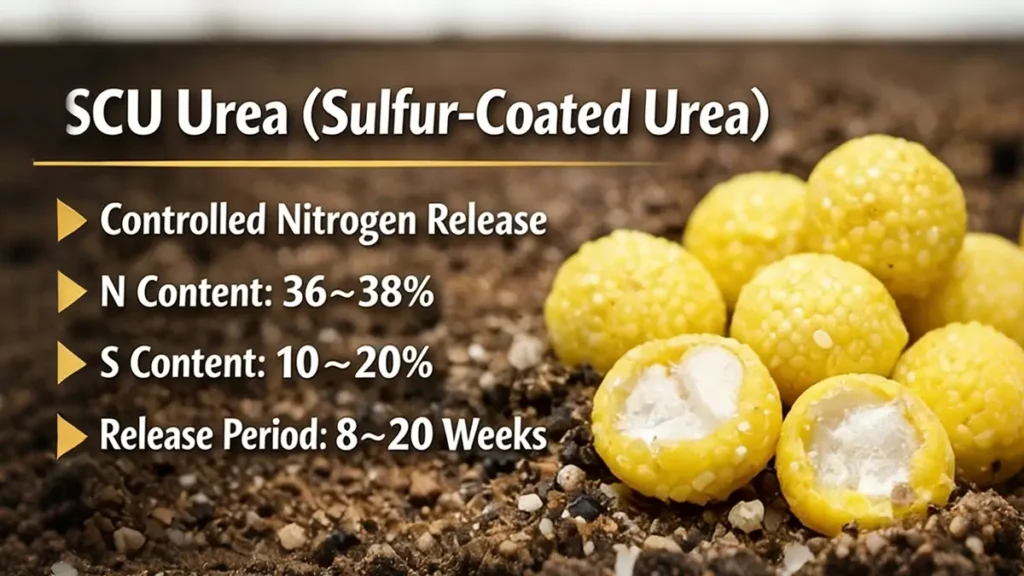
SCU Urea is produced by coating urea granules with a sulfur layer that regulates nitrogen release through controlled diffusion. This coating slows down nitrogen dissolution, allowing nutrients to be released gradually over time rather than all at once.
Compared with conventional urea fertilizers, SCU Urea offers several agronomic advantages:
- Extended nitrogen availability throughout the growing season
- Reduced nitrogen losses from volatilization, leaching, and denitrification
- Supplemental sulfur nutrition, supporting protein synthesis and enzyme activity
Fewer fertilizer applications, improving labor and cost efficiency
These characteristics make SCU Urea particularly suitable for high nitrogen-demand crops with long growth cycles, including rice, wheat, and maize.
2. Nitrogen Release Characteristics and Technical Parameters of SCU
The performance of SCU Urea depends on coating quality, sulfur content, and environmental conditions such as soil moisture and temperature. Typical technical parameters include:
- Total nitrogen (N): 36–38%
- Sulfur (S) content: 10–20%
- Initial nitrogen release (first 2–4 weeks): approximately 10–20%
- Effective nitrogen release period: 8–20 weeks
Release mechanism: moisture penetration → sulfur layer micro-cracks → nitrogen diffusion
This gradual release curve allows SCU Urea to better align nitrogen availability with crop uptake patterns, supporting steady vegetative growth and reproductive development.
3. Best SCU Urea Application Strategy for Rice
3.1 Nitrogen Demand Characteristics of Rice
Rice requires a consistent nitrogen supply from tillering through panicle initiation. However, flooded paddy soils are prone to nitrogen loss, making efficient nitrogen management critical.
3.2 Recommended SCU Application Approach
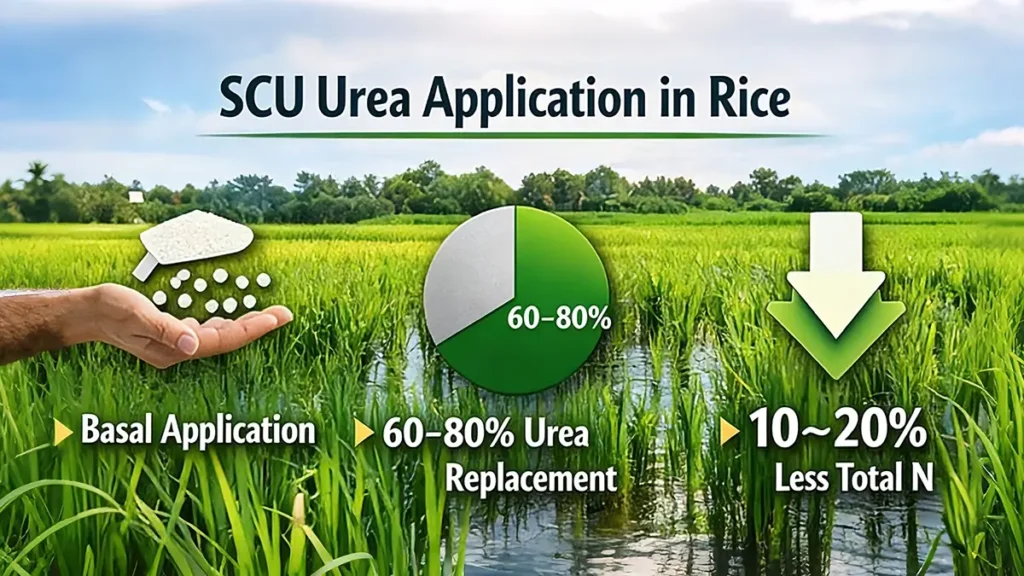
- Apply SCU Urea primarily as a basal fertilizer before transplanting or direct seeding
- Replace 60–80% of conventional urea with SCU Urea
Total nitrogen input can often be reduced by 10–20% without yield loss
Field trials have shown that SCU-treated rice maintains greener leaves during late growth stages, improves grain filling, and supports more stable yields.
4. Best SCU Urea Application Strategy for Wheat
4.1 Agronomic Rationale
Wheat has peak nitrogen demand during stem elongation and grain filling. Traditional split nitrogen applications increase management complexity, especially in large-scale production systems.
4.2 Practical Recommendations
- Apply SCU Urea mainly as basal fertilizer at planting
- SCU Urea can account for 50–70% of total nitrogen input
In high-yield systems, a small amount of fast-acting nitrogen may be applied at jointing
This strategy helps maintain nitrogen availability during critical growth stages and supports improved biomass accumulation and grain protein formation.

5. Best SCU Urea Application Strategy for Maize
5.1 Matching Nitrogen Supply with Crop Growth
Maize exhibits moderate nitrogen demand early in the season and significantly higher demand from vegetative growth to silking. SCU Urea provides a steady nitrogen supply that supports this pattern.
5.2 Recommended Use Pattern
- Apply SCU Urea at planting or early growth stages as a base nitrogen source
- SCU typically replaces 40–60% of total nitrogen fertilizer
Supplemental quick-release nitrogen may be applied at the V10–V12 stage for high-yield targets
Studies consistently show that SCU Urea improves nitrogen uptake efficiency and yield stability in maize while reducing overall nitrogen inputs.
Several global fertilizer suppliers, including Terafon Fertilizer, recommend combining SCU Urea with conventional nitrogen sources to balance early availability and long-term nutrient supply.
6. SCU Urea vs Conventional Urea: Practical Use Considerations
SCU Urea is particularly advantageous under the following conditions:
- Long growing seasons with extended nitrogen demand
- Paddy fields or light-textured soils prone to nitrogen loss
Mechanized and large-scale farming operations
In many production systems, blending SCU Urea with standard urea fertilizers delivers both immediate and sustained nitrogen availability, optimizing crop nutrition throughout the season.
7. Key Application Tips and Common Mistakes
- SCU Urea is not “maintenance-free”; application rates should still be adjusted based on soil tests
- Avoid damaging the sulfur coating during transport and mechanical spreading
High soil temperatures and moisture can accelerate nitrogen release—application strategies should be adapted accordingly
Proper handling and site-specific management are essential to fully realize the benefits of controlled-release fertilizers.
8. Summary and Agronomic Recommendations
Across rice, wheat, and maize production systems, SCU Urea offers a reliable approach to improving nitrogen efficiency, stabilizing yields, and reducing environmental impact.
Key takeaways:- Rice: basal application supports stable nitrogen supply and minimizes paddy nitrogen losses
- Wheat: sustained nitrogen release aligns with stem elongation and grain filling
Maize: steady nutrient availability supports high nitrogen demand during reproductive stages
When integrated into a balanced fertilization program, SCU Urea represents a practical and effective solution for modern, sustainable crop production.
With continued innovation in controlled-release fertilizer technologies, companies such as Terafon Fertilizer are contributing to more efficient nutrient management practices worldwide.
Frequently Asked Questions (FAQs)
Depending on coating thickness and soil conditions, SCU typically releases nitrogen over 8 to 20 weeks, supporting crop demand throughout key growth stages.
Yes. SCU aligns nitrogen release with plant uptake, often achieving higher NUE than standard urea, especially in cereals such as rice, wheat, and maize.
SCU significantly reduces nitrogen losses from ammonia volatilization and nitrate leaching, making it more environmentally sustainable than fast-release nitrogen fertilizers.
Yes. The sulfur coating supplies available sulfur, which supports protein synthesis, enzyme activity, and balanced crop nutrition.
Soil temperature, moisture, microbial activity, and coating integrity all influence nitrogen release rate and fertilizer efficiency.
SCU is widely used in rice, wheat, maize, and other field crops, but optimal performance depends on soil type, climate, and crop growth duration.
Recommended Fertilizers
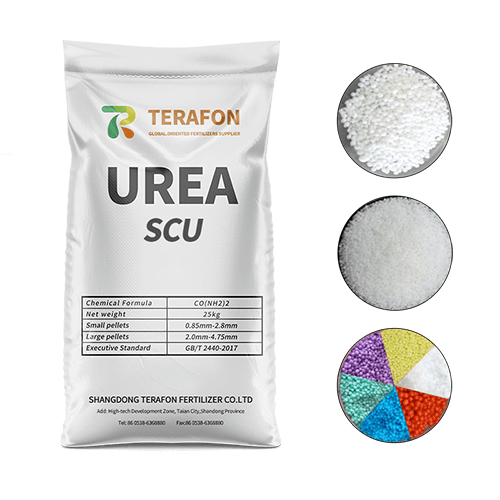
Sulfur-Coated Urea (SCU)
Polymer-Coated Urea (PCU)
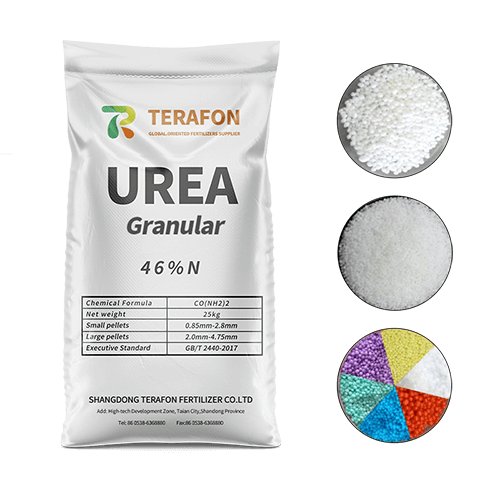
Agricultural urea
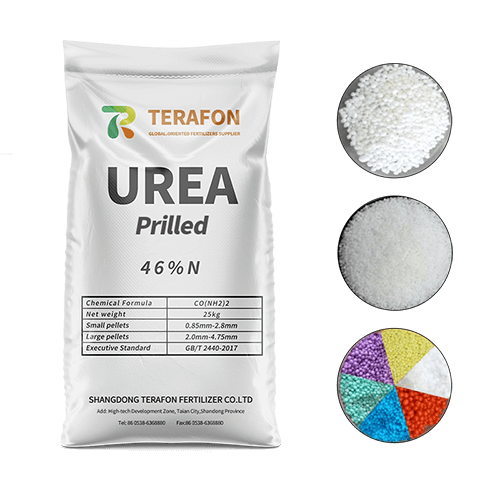
Urea 46% Prilled Fertilizer
Suitable Crops

Fruit Trees & Orchards

Legume Crops

Leafy & Fruiting Vegetables

Root & Bulb Vegetables
Choose the Right SCU Urea with Confidence
Select sulfur-coated urea based on crop type, soil conditions, and release duration to ensure steady nitrogen supply, higher nitrogen efficiency, and stable crop performance. Consult Terafon Fertilizer for professional support.
