


- Home » PCU vs SCU Urea - Controlled-Release Guide
PCU Urea vs SCU Urea - Controlled-Release Fertilizer Guide
As global agriculture continues to pursue higher nitrogen use efficiency and lower environmental impact, controlled-release urea fertilizers have become an essential solution. Among them, polymer-coated urea (PCU) and sulfur-coated urea (SCU) are two widely used options.
This article provides a professional, in-depth comparison of PCU urea and SCU urea, focusing on coating structure, nitrogen release duration, cost evolution, and field performance—helping growers, distributors, and agronomists make informed fertilizer decisions.This neutral technical overview is also part of the knowledge resources shared by Terafon Fertilizer, supporting evidence-based fertilizer selection across different cropping systems.
Table of Contents
- 1. What Is Controlled-Release Urea?
- 2. SCU Urea: Principles and Characteristics
- 3. PCU Urea: Advanced Polymer Technology
- 4. Technical Comparison: PCU vs SCU
- 5. Cost Trends and Real Usage Costs of PCU vs SCU (Key Focus)
- 6. Practical Choices for Crop Systems
- 7. Conclusion: Integrating Extended Release Fertilizers Into Modern Agriculture
1. What Is Controlled-Release Urea?
Controlled-release urea refers to urea fertilizer products that are formulated to release nitrogen gradually into the soil. These products are designed to overcome the limitations of conventional urea (rapid solubility and early nitrogen release), thereby enhancing efficient crop nitrogen uptake and reducing the risks associated with nitrogen loss pathways such as ammonia volatilization and nitrate leaching.
2. SCU Urea: Principles and Characteristics
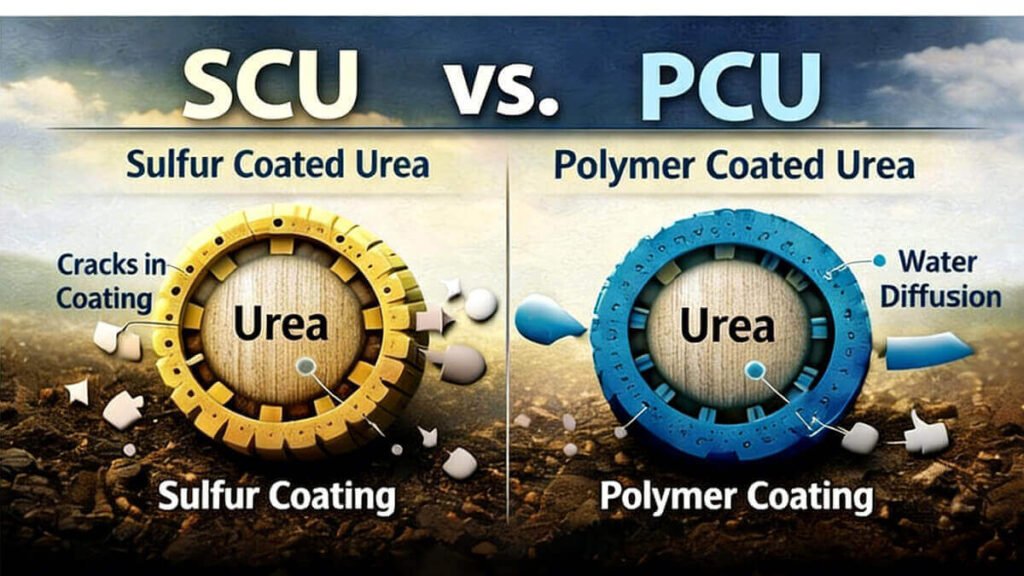
Sulfur Coated Urea (SCU) is produced by encapsulating urea granules with elemental sulfur and often a wax or sealant layer. The sulfur coating acts as a physical barrier that delays water penetration and urea dissolution. This coating slows the release of nitrogen into the soil, making SCU an early staple in slow and controlled release fertilizer technologies.
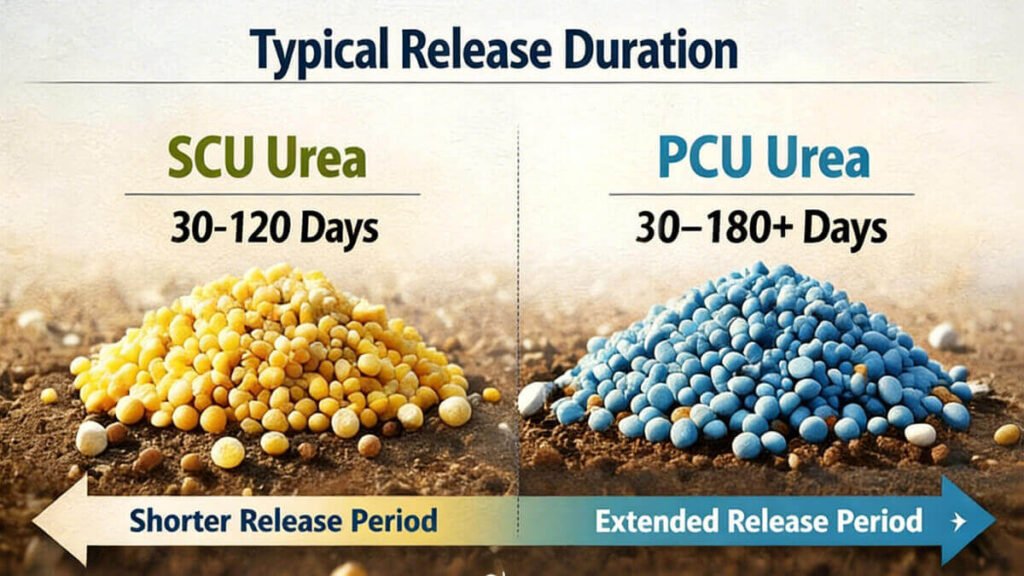
SCU’s nitrogen release duration typically spans 30–120 days, depending on coating thickness, soil moisture, temperature, and microbial activity in the field — making it suitable for medium-term nutrient supply in many crop systems.
Key features of SCU Urea:- Physically man-made sulfur barrier slows nitrogen release.
- Release controlled by water penetration and microbial degradation.
Useful in field crops where staged nutrient supply is beneficial.
3. PCU Urea: Advanced Polymer Technology
Polymer Coated Urea (PCU) utilizes a semi-permeable polymer membrane to encapsulate each urea prill. The polymer layer regulates water entry and nitrogen escape, enabling a controlled nitrogen diffusion pattern that is driven primarily by soil temperature and moisture. This results in a predictable and more uniform release pattern over a extended period.
PCU typically offers extended nitrogen release durations ranging from 30 to 180+ days, depending on the coating material and design. This makes PCU especially valuable where a long-lasting nitrogen supply is needed or where fertilizer applications should be minimized.
4. Technical Comparison: PCU vs SCU
4.1 Physical & Chemical Structure, Coating, and Release Duration
| Aspect | SCU Urea | PCU Urea |
|---|---|---|
| Coating Material | Sulfur + Optional Wax | Polymer Membrane |
| Coating Uniformity | Moderate | High |
| Chemical Stability | Degradation influenced by microbes | More resistant to fracture or early breakdown |
| Physical Resistance | Lower abrasion resistance | Higher abrasion resistance |
| Typical Release Duration | 30–120 days | 60–180+ days |
| Release Control Precision | Moderate variability | High predictability and consistency |
This table highlights how polymer coatings give PCU a significant extended release fertilizer performance, with more consistent and predictable nutrient timing that can better match crop growth patterns.
4.2 Nitrogen Release Mechanism and Stability
SCU’s nitrogen release primarily depends on cracks or imperfections in the sulfur coating, allowing water to enter and dissolve the internal urea. This mechanism can lead to some variability in the timing and pattern of nutrient release.
In contrast, PCU’s polymer coating enables water to move through microscopic pores, permitting a controlled diffusion of nitrogen that is less influenced by external soil conditions and more driven by temperature and moisture dynamics. This makes PCU more resilient in diverse conditions and better suited to precision fertilizer release strategies where synchronized supply is critical.
5. Cost Trends and Real Usage Costs of PCU vs SCU (Key Focus)
Historically, the market considered PCU Urea to be more expensive than SCU Urea, but this view no longer reflects the current industry reality.
5.1 Rising Costs of SCU
- Long-term volatility of sulfur prices
- Increased wax coating required to reduce granule cracking
- Uneven coating leading to nitrogen losses
High breakage rate during transport and application
5.2 Declining Costs of PCU
- Reduced usage of new polymer materials
- Mature automated coating technology
- Economies of scale significantly lower production cost
Higher nitrogen use efficiency reduces the number of fertilizer applications
Under current conditions, PCU Urea now generally achieves a lower total usage cost than SCU, particularly for medium- to long-term crops and precision fertilization scenarios, where its advantages are more pronounced.
6. Practical Choices for Crop Systems
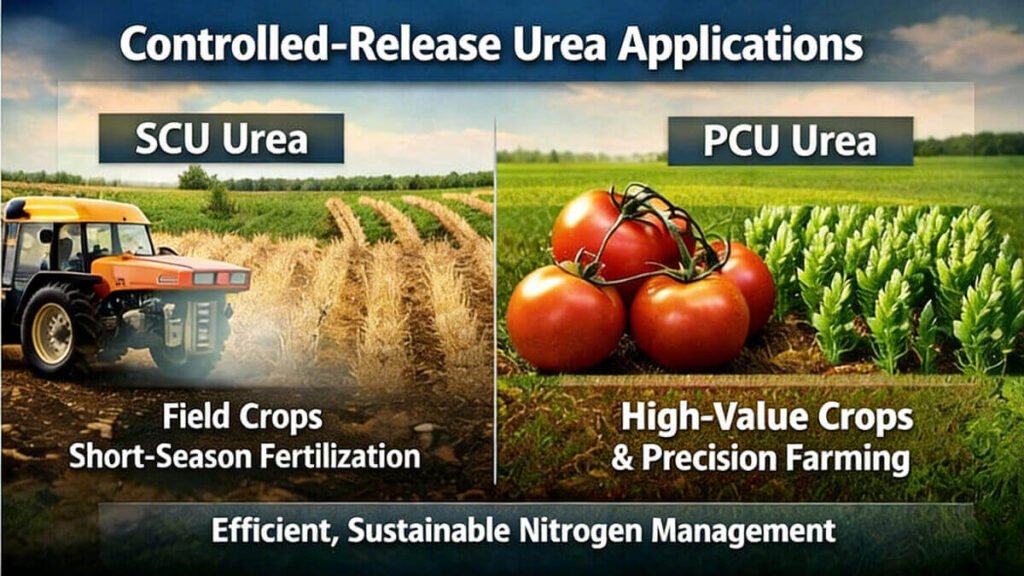
SCU Urea can be effective for hectares of staple crops where moderate nutrient staging is acceptable. Its simpler coating and shorter release durations make it suitable for crops needing early and mid-season nitrogen support without prolonged dependency.
PCU Urea is often selected for high-value fields, perennial systems, or where precision nutrient management is a priority. With its longer controlled nitrogen release duration, PCU supports:
- Reduced fertilizer frequency
- Better alignment with crop nitrogen demand curves
Lower leaching and environmental loss risk
7. Conclusion: Integrating Extended Release Fertilizers Into Modern Agriculture
In today’s agricultural landscape, controlled-release urea fertilizers represent an important tool for enhancing nitrogen management. SCU Urea provides an effective slow release nutrient supply over a moderate timeframe, making it useful in many regionally scaled cropping systems. PCU Urea extends this concept further with precision diffusion control and longer release windows that align well with long growing seasons and reduced application schedules.
When deployed thoughtfully, extended release fertilizer technology, including advanced products from Terafon Fertilizer, can improve nutrient efficiency, support sustainable soil health, and contribute to better agronomic outcomes with fewer environmental trade-offs.
8. Frequently Asked Questions (FAQs)
Yes. Both PCU and SCU enhance nitrogen use efficiency, ensuring crops absorb more nitrogen while reducing losses through leaching or volatilization. This supports higher yields and sustainable nutrient management.
Yes. Slow and timed nitrogen release minimizes ammonia volatilization and nitrate leaching compared to conventional urea, protecting soil and water while maintaining crop growth.
Both SCU and PCU improve yields versus conventional urea. PCU Urea often performs better for high-value or long-season crops due to its consistent, extended nitrogen supply.
SCU’s release is sensitive to moisture and microbial activity, while PCU’s polymer coating provides consistent nitrogen release across diverse soils and climates, making it ideal for precision agriculture.
Yes. By aligning nitrogen release with crop demand, controlled-release urea can reduce the number of applications, saving labor and optimizing fertilizer efficiency.
Recommended Fertilizers
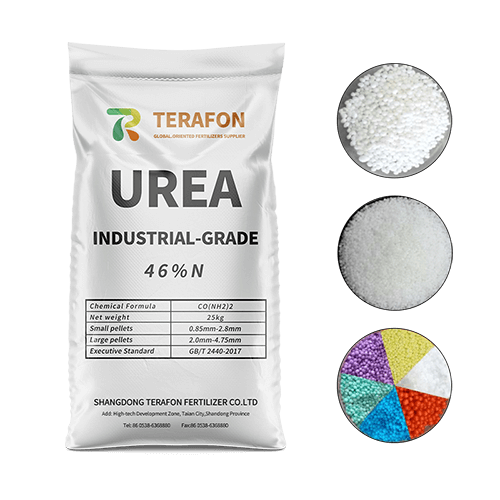
Industrial-Urea
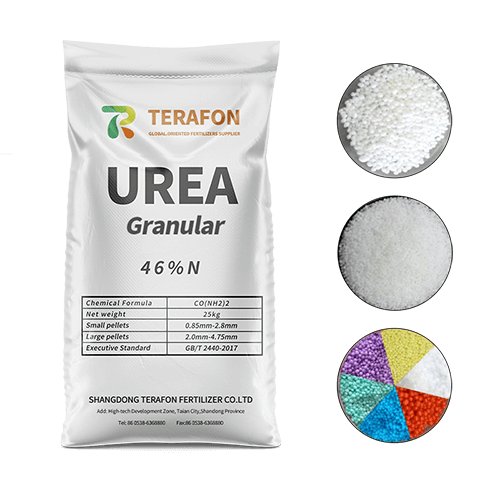
Agricultural urea
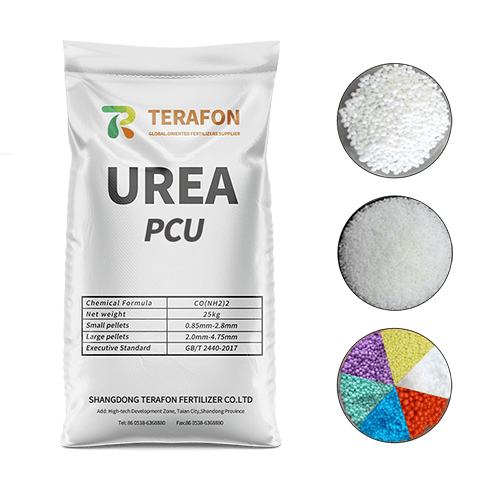
Polymer-Coated Urea (PCU)

Automotive-Grade-UreaI-(SCR)
Suitable Crops

Fruit Trees & Orchards

Berry & Vine Crops

Leafy & Fruiting Vegetables

Root & Bulb Vegetables
Choose High-Quality Food Grade Urea with Confidence
Select food grade urea based on purity level, CAS number, compliance standards, and application requirements to ensure safe use, stable performance, and consistent quality. Contact Terafon Fertilizer for professional guidance and reliable food grade urea solutions.
