


- Home » Liquid vs Granular Humic Acid Fertilizers
Liquid vs Granular Humic Acid Fertilizers | Terafon
As growers and agronomists increasingly focus on soil health, nutrient efficiency, and sustainable crop production, humic acid fertilizers have become an essential component of modern fertilization programs. However, choosing between liquid humic acid fertilizer and granular humic acid fertilizer remains a common challenge.
Based on extensive field application experience, Terafon Fertilizer works with growers worldwide to optimize humic acid fertilizer selection according to soil conditions, crop type, and application systems. This guide provides a clear, professional comparison to help you determine which formulation best fits your agronomic goals.
Table of Contents
- 1. Why the Form of Humic Acid Fertilizer Matters
- 2. Understanding Humic Acid Fertilizers
- 3. Liquid Humic Acid Fertilizers: Characteristics and Advantages
- 4. Granular Humic Acid Fertilizers: Characteristics and Advantages
- 5. Liquid vs Granular Humic Acid Fertilizers: Technical Comparison
- 6. How to Choose the Right Humic Acid Fertilizer for Your Farm
- 7. Combining Liquid and Granular Humic Acid for Best Results
- 8. Application Tips and Common Mistakes
- 9. Final Recommendation
1. Why the Form of Humic Acid Fertilizer Matters
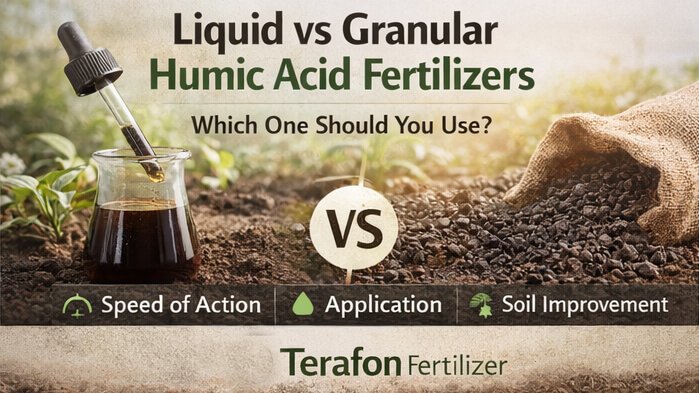
While humic acid products share similar raw materials, their formulation directly affects nutrient availability, soil interaction, and crop response. Liquid and granular humic acid fertilizers differ in how quickly they improve nutrient uptake, how long they condition the soil, and how they fit into fertigation or soil-applied programs.
Selecting the correct form is not simply a preference—it is a strategic agronomic decision that influences fertilizer efficiency, labor cost, and long-term soil productivity.
2. Understanding Humic Acid Fertilizers
Humic acid fertilizer is derived from highly humified organic materials such as leonardite or lignite. Its primary function is not to supply nutrients directly, but to enhance the soil’s ability to retain, transport, and deliver nutrients to plant roots.
In professional fertilizer programs, humic acid is valued for its ability to:- Improve soil aggregation and structure
- Increase cation exchange capacity (CEC)
- >Chelate micronutrients and reduce nutrient loss
- Stimulate root growth and microbial activity
Improve the performance of NPK and water-soluble fertilizers
For this reason, humic acid fertilizers are widely used in high-efficiency fertilization systems, including those developed by Terafon Fertilizer for commercial agriculture.
3. Liquid Humic Acid Fertilizers: Characteristics and Advantages
Rapid Nutrient Uptake and Crop Response
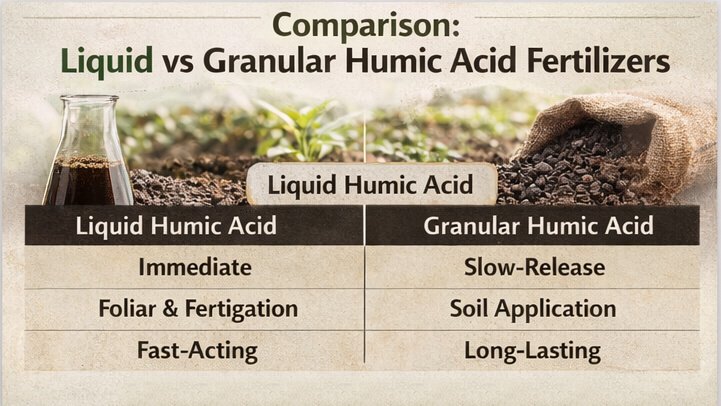
Because liquid humic acid is readily available in solution, it improves nutrient uptake efficiency shortly after application. This makes it suitable for correcting nutrient stress, supporting transplant establishment, and enhancing early root development.
Flexible Application Methods
Liquid formulations integrate seamlessly with fertigation systems, drip irrigation, foliar spraying, and soil drenches, making them ideal for precision agriculture and high-value crops.
Ideal for In-Season Fertility Management
When crops demand quick physiological support, liquid humic acid fertilizer allows growers to respond efficiently without increasing total fertilizer input.
4. Granular Humic Acid Fertilizers: Characteristics and Advantages
Long-Lasting Soil Improvement
Once applied, granular humic acid gradually releases humic substances, improving soil structure, water retention, and microbial activity over an extended period.
Foundation for Pre-Plant Fertility Programs
Granular products are commonly used as base amendments before planting, especially in large-scale field crops, orchards, and perennial systems where soil health is built over seasons rather than weeks.
Reduced Application Frequency
Because of their slow-release nature, granular humic acid fertilizers typically require fewer applications, making them cost-effective for broad-acre farming.
5. Liquid vs Granular Humic Acid Fertilizers: Technical Comparison
From a practical agronomic perspective, the difference between liquid and granular humic acid fertilizers can be summarized by speed versus persistence.
Liquid humic acid fertilizers act quickly, improving nutrient mobility and root uptake within a short time frame. Granular humic acid fertilizers work more gradually, delivering long-term improvements in soil structure and nutrient retention.
This distinction explains why many fertilizer programs designed by Terafon Fertilizer incorporate both forms at different stages of the crop cycle.
6. How to Choose the Right Humic Acid Fertilizer for Your Farm
- Crop growth stage: Early growth and stress recovery favor liquid applications, while pre-plant preparation favors granular forms.
- Soil condition: Degraded, compacted, or low-organic-matter soils benefit from granular humic acid, while sandy or low-CEC soils respond well to liquid applications.
- Application system: Farms using drip irrigation or fertigation naturally benefit from liquid humic acid fertilizers.
Management objectives: Short-term nutrient efficiency and long-term soil improvement often require different formulations.
7. Combining Liquid and Granular Humic Acid for Best Results
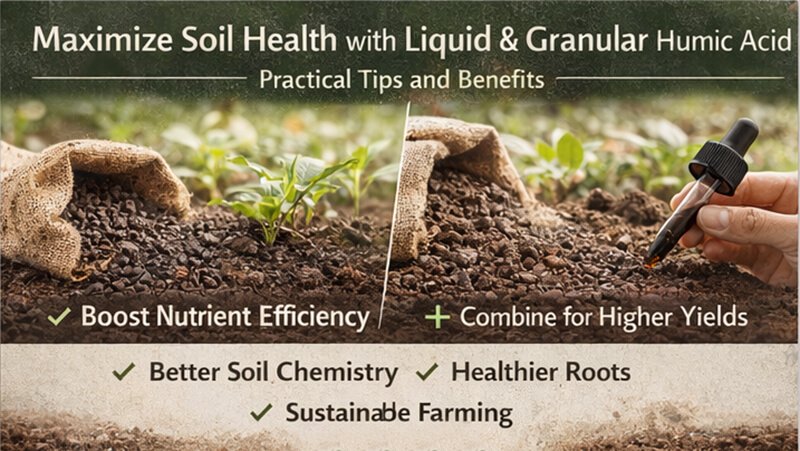
In practice, the most effective fertilization strategy is not choosing one over the other, but using liquid and granular humic acid fertilizers together.
A common integrated approach includes:- Applying granular humic acid fertilizer before planting to build soil structure and biological activity
Supplementing with liquid humic acid fertilizer during key growth stages to enhance nutrient uptake and root performance
This combined strategy improves fertilizer efficiency, supports stable yields, and promotes sustainable soil health—an approach strongly recommended by Terafon Fertilizer for modern agricultural systems.
8. Application Tips and Common Mistakes
A frequent mistake is expecting granular humic acid to deliver immediate visible crop responses. Its benefits accumulate gradually through soil improvement.
Conversely, relying solely on liquid humic acid without addressing underlying soil structure limitations may restrict long-term performance.
Best results are achieved when humic acid fertilizer selection is guided by soil testing, crop demand, and seasonal planning, rather than short-term observation alone.
9. Final Recommendation
When evaluating liquid vs granular humic acid fertilizers, the correct choice depends on your specific agronomic objectives.
- Liquid humic acid fertilizer is ideal for rapid nutrient efficiency, fertigation, and in-season crop support
- Granular humic acid fertilizer is best suited for soil conditioning, organic matter improvement, and long-term fertility
Combining both delivers the most consistent and sustainable results
For growers seeking reliable, science-based humic acid solutions, Terafon Fertilizer provides integrated formulations designed to improve soil performance, nutrient efficiency, and crop productivity across diverse agricultural systems.
Recommended Fertilizers
Urea Fertilizer
View Solutions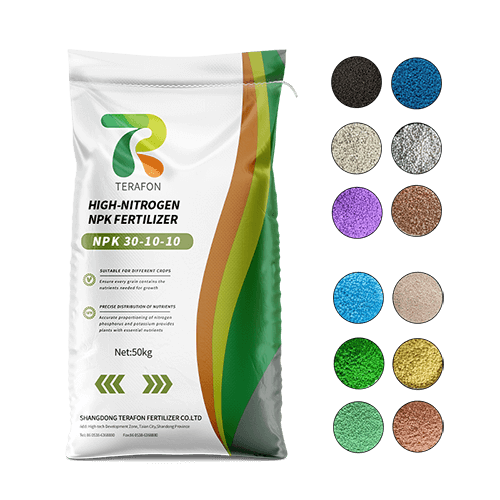
NPK Fertilizer
View Solutions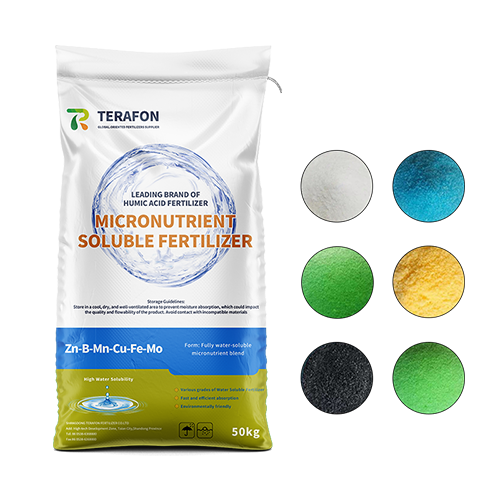
Water Soluble Fertilizer
View Solutions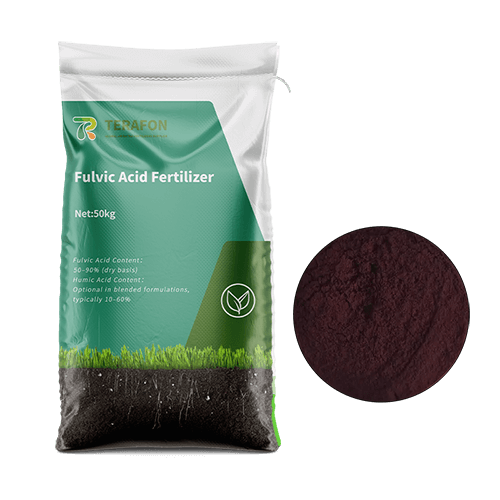
Fulvic-Acid-Fertilizer
View SolutionsSuitable Crops
Cereal Crops

Legume Crops
Root & Tuber Crops
Fruit Crops
Liquid vs Granular Humic Acid Fertilizers for Soil Health
Compare liquid and granular humic acid fertilizers for fast nutrient uptake and long-term soil improvement. Contact Terafon Fertilizer for expert guidance and tailored solutions to enhance crop performance.
