


- Home » How to Choose Potassium, Sodium...
How to Choose Potassium, Sodium & Ammonium Humate
A Professional, Stage-Based Nutrition Guide for Modern Orchards
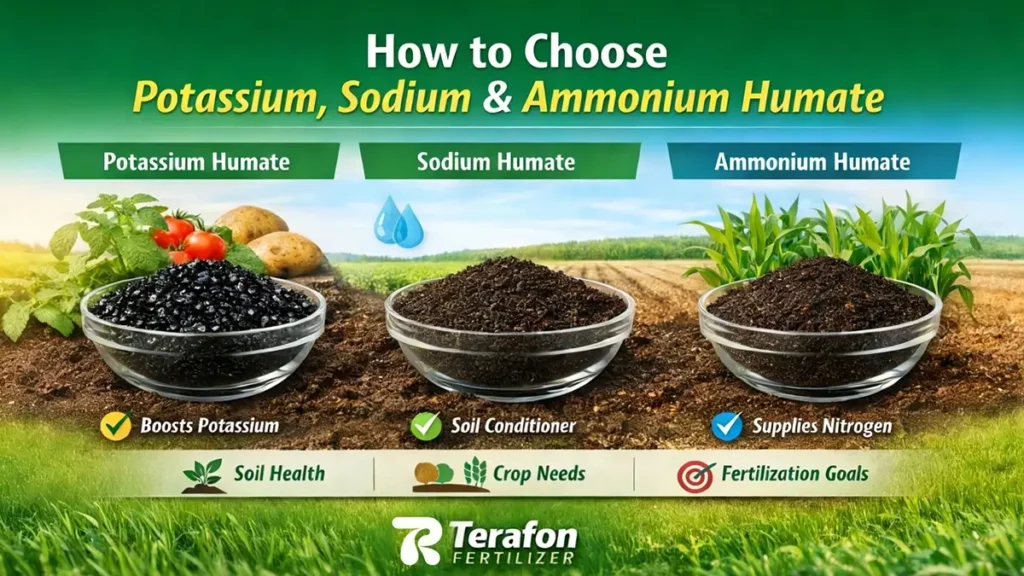
In modern agriculture, understanding how to choose the right humate fertilizer has become increasingly important for growers, agronomists, and agricultural input buyers. Among the most commonly used products, Potassium Humate, Sodium Humate, and Ammonium Humate are often compared due to their similar origin but different agronomic functions.
Choosing the right type of humate directly affects soil improvement efficiency, nutrient availability, fertilizer use efficiency, and long-term soil health. This article provides professional and in-depth information to help you clearly understand the differences between these three types of humic acid and make an informed choice based on crop needs and soil conditions.
Supported by professional insights from Terafon Fertilizer, a supplier focusing on efficient and sustainable humic-based fertilizer solutions.
Table of Contents
- 1. The Role of Humates in Modern Agriculture
- 2. Overview of Potassium, Sodium, and Ammonium Humate
- 3. How to Choose Humates Based on Fertilization Goals
- 4. How to Select Humates According to Soil Conditions
- 5. Detailed Comparison Table of Three Humates
- 6. Crop-Based and Application Scenario Recommendations
- 7. Professional Summary and Practical Selection Strategy
- 8. Frequently Asked Questions (FAQs) — Humate Fertilizers
1. The Role of Humates in Modern Agriculture
Humates are water-soluble salts derived from natural humic acid, typically extracted from leonardite or lignite. As a key component of organic soil conditioners and functional fertilizers, humates play an essential role in improving soil fertility and crop performance.
Extensive research and field applications show that humic-based fertilizers can:
Extensive research and field applications show that humic-based fertilizers can:
- Improve soil structure and reduce compaction
- Increase water retention and aeration in the root zone
- Chelate macro- and micronutrients, enhancing nutrient availability
- Stimulate root development and beneficial microbial activity
- Improve fertilizer efficiency when combined with NPK or water-soluble fertilizers
2. Overview of the Three Main Types of Humates
2.1 Potassium Humate – Soil Improvement Plus Potassium Nutrition
Potassium Humate is the most widely used humate fertilizer in commercial agriculture. In addition to the core benefits of humic substances, it supplies potassium (K), an essential macronutrient for plant growth.
Key agronomic benefits of potassium humate include:
Key agronomic benefits of potassium humate include:
- High water solubility, suitable for drip irrigation, fertigation, and foliar application
- Dual function as a soil conditioner and potassium fertilizer
- Improved stress tolerance, including drought and temperature stress
- Enhanced photosynthesis, sugar transport, and fruit quality
2.2 Sodium Humate – A Dedicated Soil Conditioner
Sodium Humate focuses primarily on soil structure improvement rather than direct nutrient supply. While sodium is not an essential plant nutrient, sodium humate is effective as a soil conditioning agent.
Its main functions include:
In searches such as sodium humate soil conditioner uses, this product is often associated with land restoration, organic matter rebuilding, and baseline soil improvement projects.However, application rates must be managed carefully, especially in sodium-sensitive or saline soils, to avoid potential salt accumulation.
Its main functions include:
- Increasing soil organic matter content
- Improving aggregate stability and soil porosity
- Enhancing microbial activity and nutrient exchange capacity
- Supporting long-term soil fertility improvement programs
In searches such as sodium humate soil conditioner uses, this product is often associated with land restoration, organic matter rebuilding, and baseline soil improvement projects.However, application rates must be managed carefully, especially in sodium-sensitive or saline soils, to avoid potential salt accumulation.
2.3 Ammonium Humate – Soil Conditioning with Nitrogen Support
Ammonium Humate combines the benefits of humic substances with ammonium nitrogen (NH₄⁺), making it suitable for fertilization programs that require both soil improvement and nitrogen supplementation.
Key advantages include:
Growers often search for ammonium humate nitrogen fertilizer when looking for solutions that integrate organic soil conditioning with essential nutrient supply.
Key advantages include:
- Providing a readily available nitrogen source
- Improving nitrogen use efficiency and reducing leaching losses
- Enhancing root activity and early-stage crop growth
- Supporting base fertilization and soil fertility rebuilding
Growers often search for ammonium humate nitrogen fertilizer when looking for solutions that integrate organic soil conditioning with essential nutrient supply.
3. Choosing Humates Based on Fertilization Goals
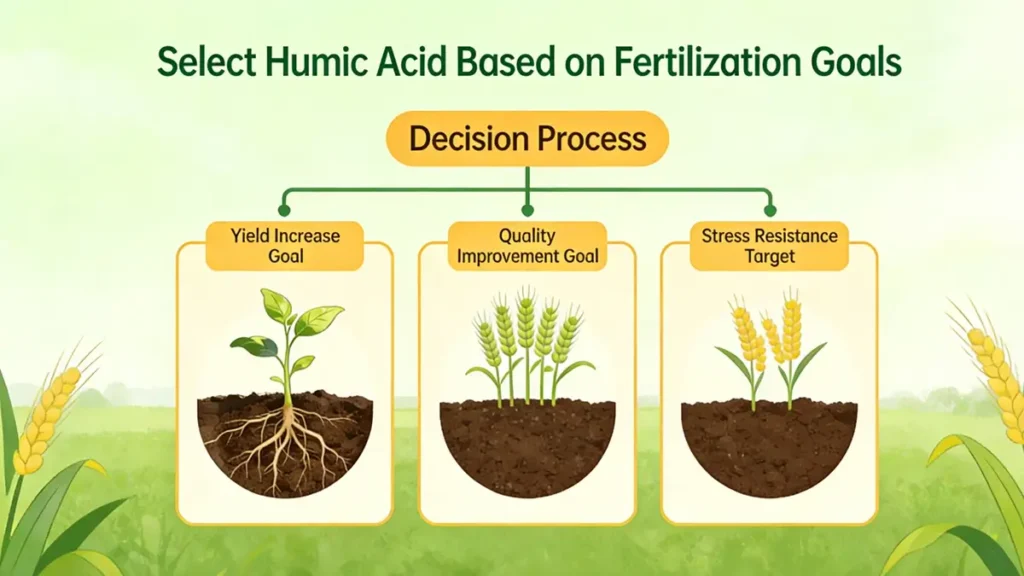
A practical way to select the right humate is to start with clear fertilization objectives:
This goal-oriented approach is commonly used when comparing potassium humate vs sodium humate vs ammonium humate in professional fertilization planning.
- For yield improvement and potassium supplementation, potassium humate is the preferred option
- For long-term soil structure improvement and organic matter enhancement, sodium humate offers cost-effective performance
- For nitrogen supplementation combined with soil conditioning, ammonium humate is more suitable
This goal-oriented approach is commonly used when comparing potassium humate vs sodium humate vs ammonium humate in professional fertilization planning.
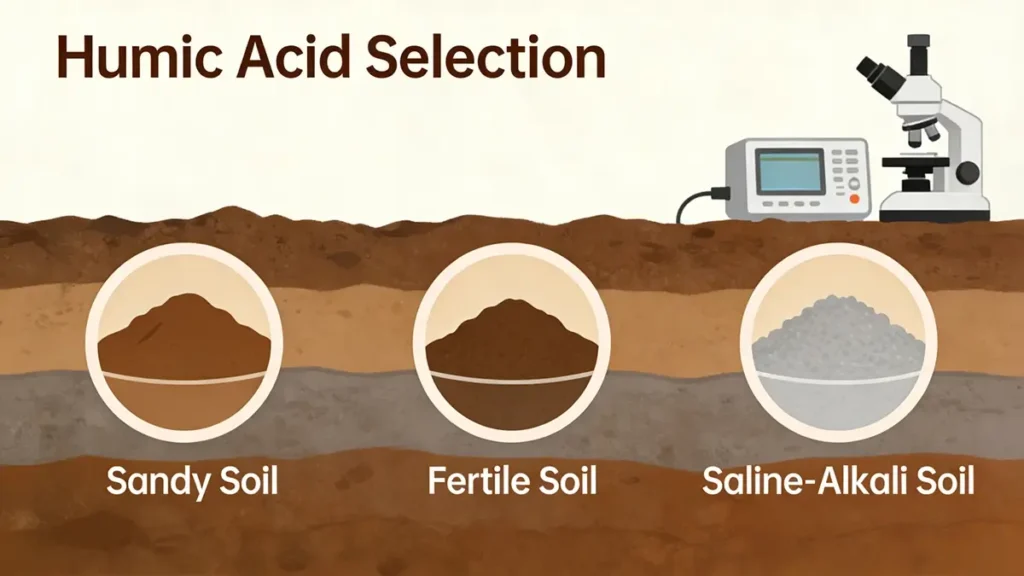
4. Selecting Humates According to Soil Conditions
Soil characteristics play a decisive role in humate selection:
Matching the humate type to soil conditions is essential for achieving the best humic acid fertilizer for soil improvement.
- Potassium-deficient or stress-prone soils benefit more from potassium humate
- Low-organic-matter or structurally degraded soils respond well to sodium humate
- Nitrogen-poor soils or soils with low fertilizer retention capacity are suitable for ammonium humate
Matching the humate type to soil conditions is essential for achieving the best humic acid fertilizer for soil improvement.
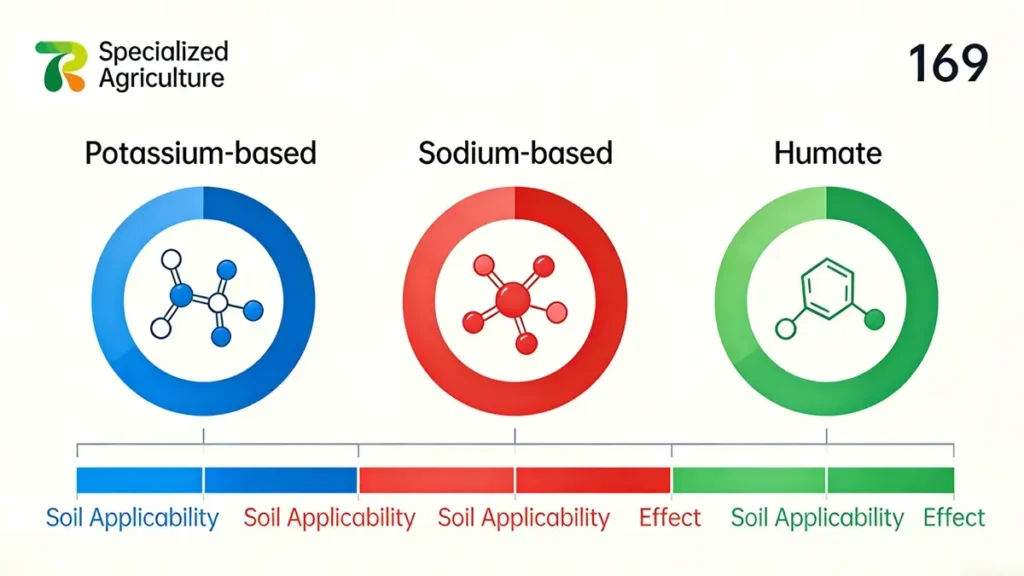
5. Detailed Comparison Table of Potassium, Sodium, and Ammonium Humate
| Parameter | Potassium Humate | Sodium Humate | Ammonium Humate |
|---|---|---|---|
| Primary Function | Soil improvement + K nutrition | Soil improvement | Soil improvement + N supply |
| Nutrient Contribution | Potassium (K) | None | Ammonium Nitrogen (NH₄⁺) |
| Water Solubility | High | High | High |
| Best Application Focus | High-yield & cash crops | Soil conditioning programs | Nitrogen-demanding crops |
| Potential Risk | Low risk of K excess | Sodium accumulation if overused | Nitrogen imbalance if misapplied |
6. Crop-Based and Application Scenario Recommendations
In practical farming systems:
At this stage, many agronomists also integrate product solutions from Terafon Fertilizer into their humate-based fertilization strategies, especially when consistency, solubility, and formulation compatibility are required.
- Fruit, vegetable, and greenhouse crops benefit most from potassium humate fertigation programs
- Field crops and long-term soil rehabilitation projects can integrate sodium humate periodically
- Leafy vegetables and fast-growing crops respond well to ammonium humate during early growth stages
At this stage, many agronomists also integrate product solutions from Terafon Fertilizer into their humate-based fertilization strategies, especially when consistency, solubility, and formulation compatibility are required.
7. Professional Summary and Practical Selection Strategy
There is no single humate product suitable for all crops and soil conditions. The most effective strategy is to select or combine potassium humate, sodium humate, and ammonium humate based on specific agronomic goals, soil characteristics, and crop nutrient demands.
Potassium humate is ideal for improving yield and quality, sodium humate excels in soil structure enhancement, and ammonium humate provides balanced soil conditioning with nitrogen support.
From a long-term perspective, working with reliable suppliers such as Terafon Fertilizer can help ensure product quality and technical consistency, supporting sustainable agriculture and optimized fertilizer efficiency without compromising agronomic neutrality.
8. Frequently Asked Questions (FAQs) — Humate Fertilizers
Humic acid is a natural organic substance formed from decomposed plant matter, known for improving soil structure and nutrient availability. Humate fertilizers, such as potassium humate, sodium humate, and ammonium humate, are alkali-soluble salts of humic acid, offering much higher solubility and bioavailability. As a result, humates are more effective and practical for modern agricultural applications than raw humic acid.
Yes. Potassium humate is highly compatible with most NPK fertilizers and nitrogen sources such as urea. When applied together, it can enhance nutrient uptake, reduce nitrogen losses, and improve phosphorus availability in the soil. This combination helps increase overall fertilizer efficiency and supports balanced crop nutrition. Compatibility testing is recommended before large-scale mixing.
Ammonium humate provides both humic substances and ammonium nitrogen (NH₄⁺) in a single product. This dual function improves nitrogen retention in the soil while enhancing root development and microbial activity. It is especially effective during early growth stages and in soils with low organic matter or poor nutrient-holding capacity.
Application rates depend on humic acid content, crop type, soil conditions, and method of application. High-quality humate fertilizers with higher humic content require lower dosages. For best results, follow manufacturer recommendations and base application decisions on soil analysis to avoid over- or under-application.
Yes. Humate fertilizers improve soil aggregation, increase organic matter content, and enhance water retention and aeration. By stimulating beneficial microbial activity and binding soil particles, humates help restore degraded soils and improve long-term soil fertility and productivity.
Yes. Humate fertilizers perform best within a moderate pH range. Excessively high pH can reduce nutrient availability and effectiveness. For liquid or foliar applications, maintaining a near-neutral pH helps maximize solubility and plant absorption, ensuring consistent performance.
Get a Catalog & Best Price
Recommended Fertilizers
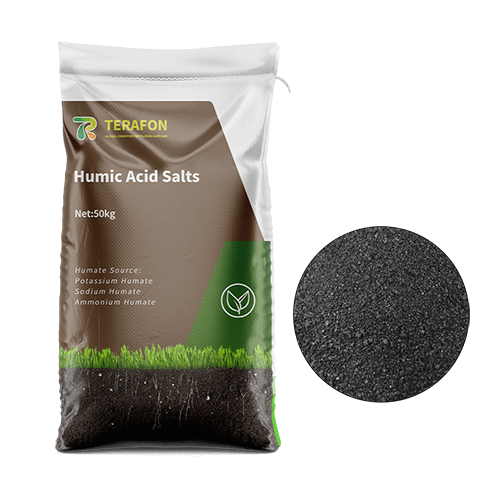
Humic Acid Salts
Potassium Humate Fertilizer
Sodium Humate Fertilizer
Ammonium Humate Fertilizer
Suitable Crops

Fruit Trees & Orchards

Berry & Vine Crops

Leafy & Fruiting Vegetables
Root & Bulb Vegetables
Choose the Right Water Soluble Fertilizer for Your Fruit Trees
Select the best water soluble fertilizer based on fruit tree type, growth stage, and soil conditions to ensure rapid nutrient availability, improve uptake efficiency, and enhance fruit quality. Contact Terafon Fertilizer for expert guidance and customized water soluble fertilizer solutions.
