


- Home » Food Grade Urea vs Industrial Urea...
Food Grade Urea vs Industrial Urea: Uses, Safety & Selection
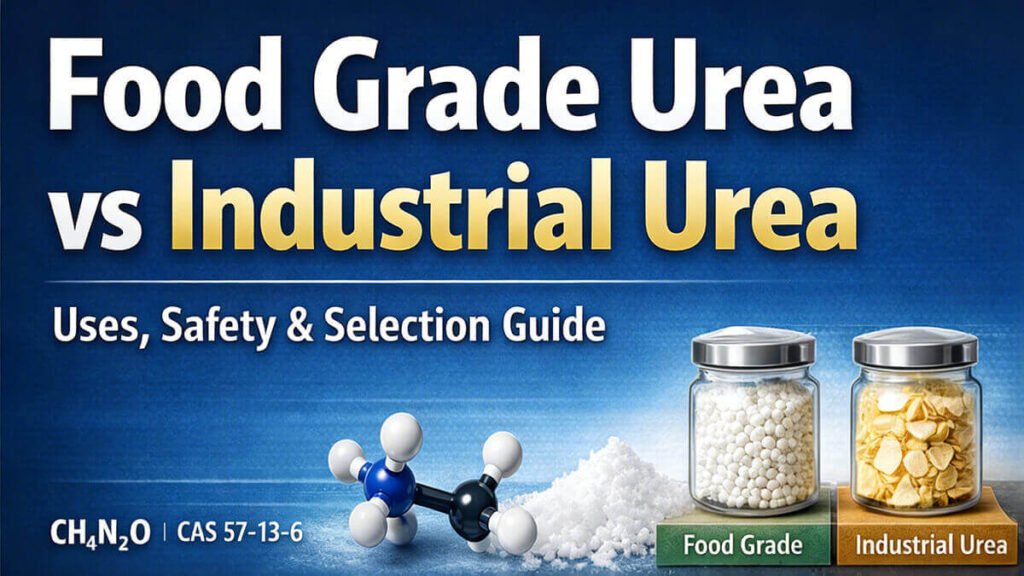
Compare food grade urea and industrial urea, including their applications, technical specifications, and safety standards. Learn how to choose the right urea grade for food processing, fermentation, or industrial use to ensure compliance, quality, and consistent performance.
Table of Contents
- 1. Introduction: What Is Urea?
- 2. Understanding Food Grade Urea vs Industrial Urea
- 3. Key Technical Specifications Comparison
- 4. Applications and Industry Uses
- 5. Quality Control and Safety Standards
- 6. How to Choose the Right Urea Grade
- 7. Conclusion and Best Practices
- 8. Frequently Asked Questions (FAQs)
1. Introduction: What Is Urea?
Urea (CH₄N₂O, CAS 57‑13‑6) is a nitrogen-rich organic compound, available as white crystalline or pale yellow flakes, widely used in agriculture, chemical manufacturing, and specialized food processing.
High-purity urea is critical in fermentation systems, enzymatic reactions, and food-related processes, where precision and consistency directly impact product quality and safety.
Suppliers like Terafon Fertilizer ensure the consistent purity and batch traceability required for regulated food and industrial applications.
2. Understanding Food Grade Urea vs Industrial Urea
🧪 Food Grade Urea
Food grade urea is a high-purity nitrogen source for food processing and fermentation. Its production adheres to strict regulatory and safety standards, controlling heavy metals, biuret, and other impurities to ensure safe use in:
- Fermentation systems for yeast and microbial cultures
Food processing aids under controlled conditions
🏭 Industrial Urea
Industrial or technical grade urea is primarily used in chemical and industrial applications such as:
- Resin and plastic production (urea-formaldehyde resins, melamine)
- Rubber, textile, and coating additives
Diesel exhaust fluid (DEF/AdBlue) for NOx emission reduction
Industrial urea focuses on chemical stability and solubility, not food safety.
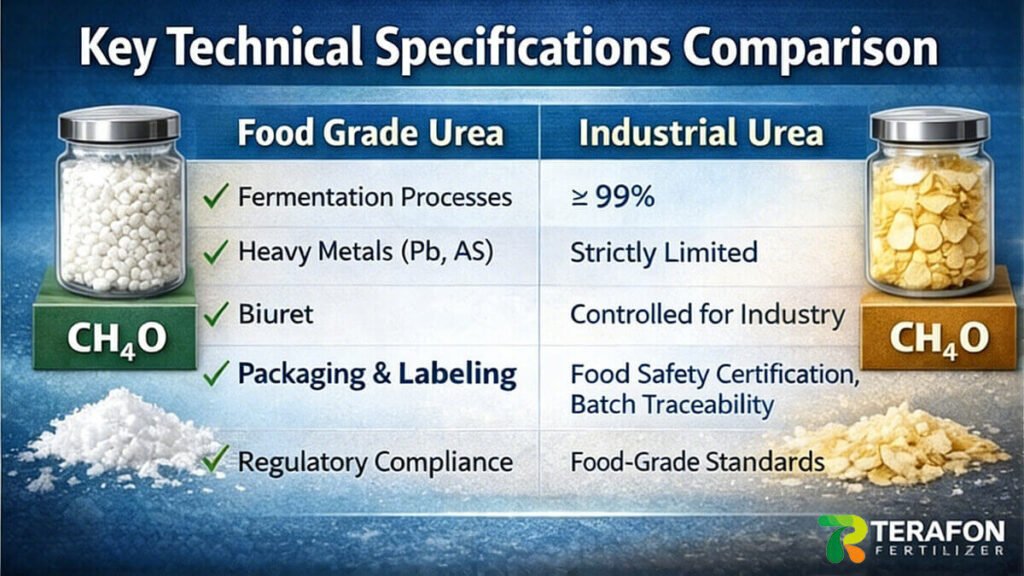
3. Key Technical Specifications Comparison
| Specification | Food Grade Urea | Industrial Urea |
|---|---|---|
| Urea content (%) | ≥ 99.0% | ≥ 99% (varies by manufacturer) |
| Nitrogen content | ~46% | ~46% |
| Heavy metals (Pb, As) | Strictly limited | Not strictly controlled |
| Biuret | Low (ensures safety for food/fermentation) | Controlled for industrial purposes |
| Packaging & labeling | Food safety certification, batch traceability | Industrial labeling, batch numbers |
| Regulatory compliance | Food-grade standards | Industrial/technical standards |
Always verify supplier COA (Certificate of Analysis) to ensure batch-to-batch consistency.
4. Applications and Industry Uses
🍽 Food Grade Urea Applications
- Fermentation processes: Supports nitrogen metabolism and microbial growth
Food processing aids: Enhances specific reactions in controlled food systems
⚠️ Usage must comply with local and international food regulations.
🏭 Industrial Urea Applications
- Chemical intermediates: Melamine, urea-formaldehyde resins, adhesives
- Plastics and specialty chemicals: Industrial additives for polymers and coatings
- Diesel exhaust fluid (DEF/AdBlue): Reduces NOx emissions in SCR systems
Other industrial processes: Textiles, rubber, and coatings
For sourcing and compliance in both food and industrial applications, Terafon Fertilizer offers technical guidance and customized supply solutions.
5. Quality Control and Safety Standards
Food Grade Urea
- Technical specifications & COA per batch
- Produced under GMP standards for food and fermentation
Fully compliant with local and international food regulations
Industrial Urea
- Focused on chemical purity, solubility, and particle size
- Packaging meets industrial transport standards
Safety controls aligned with industrial use
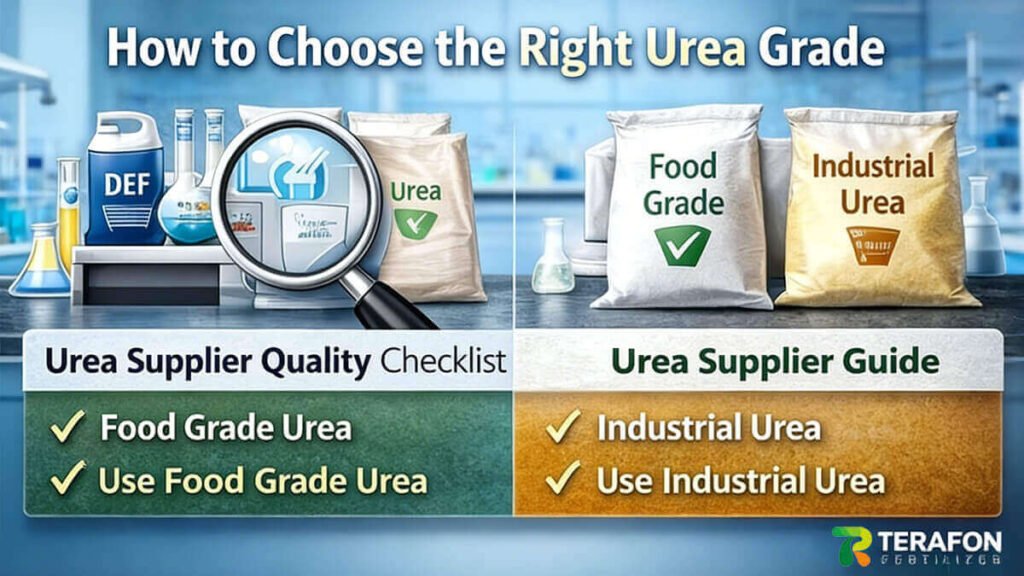
6. How to Choose the Right Urea Grade
✔ Determine Your Application
- Food processing or fermentation → Select food grade urea
Industrial manufacturing, DEF production, or chemical applications → Industrial urea
✔ Verify Supplier Quality
- Confirm technical specifications
- Review COA / quality report
Check for regulatory compliance in food-related applications
Expert suppliers like Terafon Fertilizer can provide consultation to ensure correct grade selection, regulatory compliance, and consistent performance.
7. Conclusion and Best Practices
Understanding the difference between food grade urea and industrial urea is crucial for:
- Regulatory compliance
- Process safety
- Consistent product quality
- Food grade urea: High purity, low impurities, suitable for fermentation and food processing
Industrial urea: Optimized for chemical manufacturing and environmental applications
Proper grade selection minimizes risks and ensures smooth operation in both food and industrial applications.
For reliable sourcing, batch verification, and application-specific advice, Terafon Fertilizer remains a trusted partner.
8. Frequently Asked Questions (FAQs)
Q1: Can industrial urea be used in food processing?
A1: No. Industrial urea does not meet food safety standards and may contain contaminants unsafe for consumption.
Q2: What is the difference in purity between food grade and industrial urea?
A2: Food grade urea typically has ≥99% urea content with strict limits on heavy metals and biuret, whereas industrial urea focuses on chemical stability and may not be food-safe.
Q3: How is food grade urea verified for safety?
A3: It is verified via Certificates of Analysis (COA), batch traceability, and compliance with GMP and local food regulations.
Q4: What applications require food grade urea instead of industrial urea?
A4: Fermentation processes, enzymatic reactions, and controlled food processing applications require food grade urea for safety and regulatory compliance.
Q5: Who can provide guidance on selecting the right urea grade?
A5: Trusted suppliers like Terafon Fertilizer offer expert advice, customized solutions, and full compliance documentation to ensure safe and effective urea use.
Recommended Fertilizers
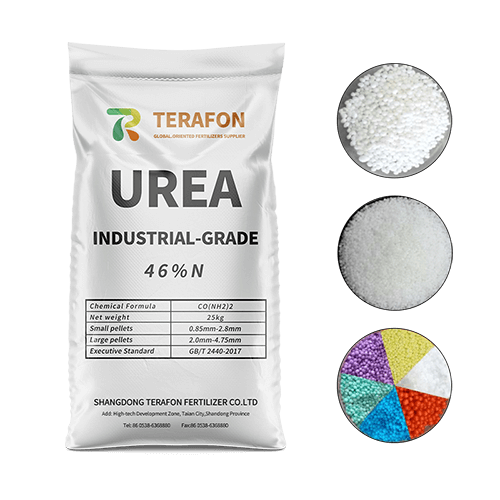
Industrial-Urea
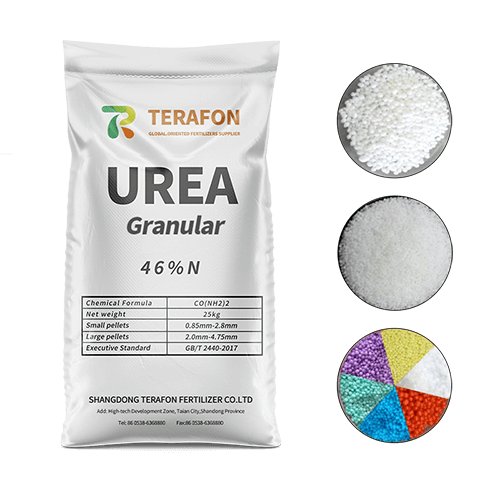
Agricultural urea
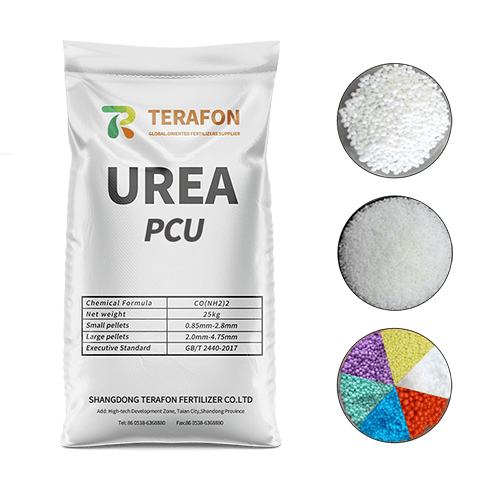
Polymer-Coated Urea (PCU)

Automotive-Grade-UreaI-(SCR)
Suitable Crops
Fruit Trees & Orchards

Berry & Vine Crops

Leafy & Fruiting Vegetables
Root & Bulb Vegetables
Choose the Right Urea Grade for Your Application
Select food grade or industrial urea based on your process type, application, and quality needs to ensure safety, consistent performance, and regulatory compliance. Contact Terafon Fertilizer for expert guidance and tailored urea solutions.
